
Plate Tube Heat Exchangers
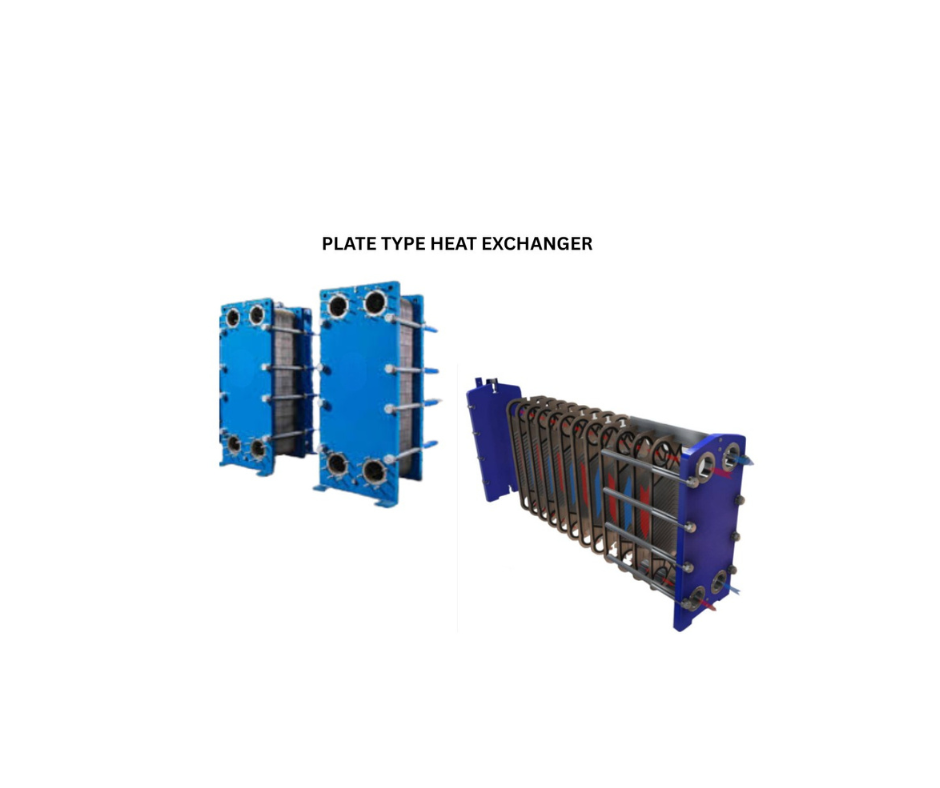
Plate Heat Exchangers are designed for applications where high heat transfer efficiency, compact footprint, and close temperature approach are required.
Plate heat exchangers use corrugated metal plates to create intense turbulence at relatively low flow rates. This significantly improves the overall heat transfer coefficient while reducing space requirements.
Atmax Filtration supplies industrial plate heat exchangers engineered for manufacturing facilities, utility systems, and oil & gas support operations across the USA and the Middle East.
Operating Principle of Plate Heat Exchangers
A plate heat exchanger consists of a series of thin, corrugated metal plates assembled into a frame. The plates are arranged to form alternating flow channels.
- Hot fluid flows in every alternate channel
- Cold fluid flows in the adjacent channels
- Heat transfers through the plate surface
- Fluids remain physically separated
The corrugation pattern increases surface area and induces turbulence, which enhances convective heat transfer and reduces fouling compared to laminar flow conditions.
Because of this turbulence, plate heat exchangers typically achieve higher overall heat transfer coefficients than shell & tube units of similar duty.
Types of Plate Heat Exchangers
1.Gasketed Plate Heat Exchangers: Featuring removable plates for easy mechanical cleaning and modular expansion . Rated for temperatures up to 200°C and pressures up to 25 bar .
2.Brazed Plate Heat Exchangers: A compact, leak-free, and maintenance-free solution where all plates are brazed together . Ideal for refrigeration and clean service up to 45 bar .
3.Welded/Semi-Welded Plate Exchangers: Designed for hydrocarbons and aggressive chemicals that would degrade standard gaskets . Rated for temperatures up to 350°C.
Thermal Design Parameters
Proper sizing requires detailed evaluation of:
- Heat duty (kW or kcal/hr)
- Inlet and outlet temperatures
- Log Mean Temperature Difference (LMTD)
- Overall heat transfer coefficient (U-value)
- Fouling factors
- Allowable pressure drop
- Fluid viscosity and density
Due to high turbulence, plate heat exchangers often achieve closer temperature approaches compared to shell & tube designs. This allows for more efficient heat recovery in compact systems.
However, pressure drop must be carefully controlled. Excessively narrow channel spacing can increase pumping energy requirements.
Advantages of Plate Heat Exchangers
a. High Heat Transfer Efficiency:-Corrugated plate geometry promotes turbulence, increasing heat transfer rates even at relatively low flow velocities.
b. Compact Footprint:- For equivalent heat duty, plate heat exchangers typically require significantly less floor space than traditional shell & tube units.
c. Close Temperature Approach:- Plate designs allow smaller temperature differences between outlet streams, making them ideal for heat recovery and energy optimization.
d. Modular Capacity Expansion:- Gasketed plate heat exchangers can be expanded by adding additional plates if process demand increases.
e. Ease of Maintenance:- Units can be opened for inspection and plate cleaning, reducing long-term maintenance costs.
Contact Atmax for Plate Heat Exchanger Sizing: 📧 sales@atmaxfiltration.com
Download Brochure
Let’s Start Work Together
- 2101 Park Ave, South Plainfield New Jersey 07080, USA
- sales@atmaxfiltration.com
- (816) 745-9994
- Mon – Fri : 8:00 AM to 7:00 PM
Atmax Filtration provides high quality dust collectors and accessories and supplies in the entire New Jersey.
For more information talk to us on (816)-745-9994 or write at sales@atmaxfiltration.com
No posts found!