
Industrial Control Panels
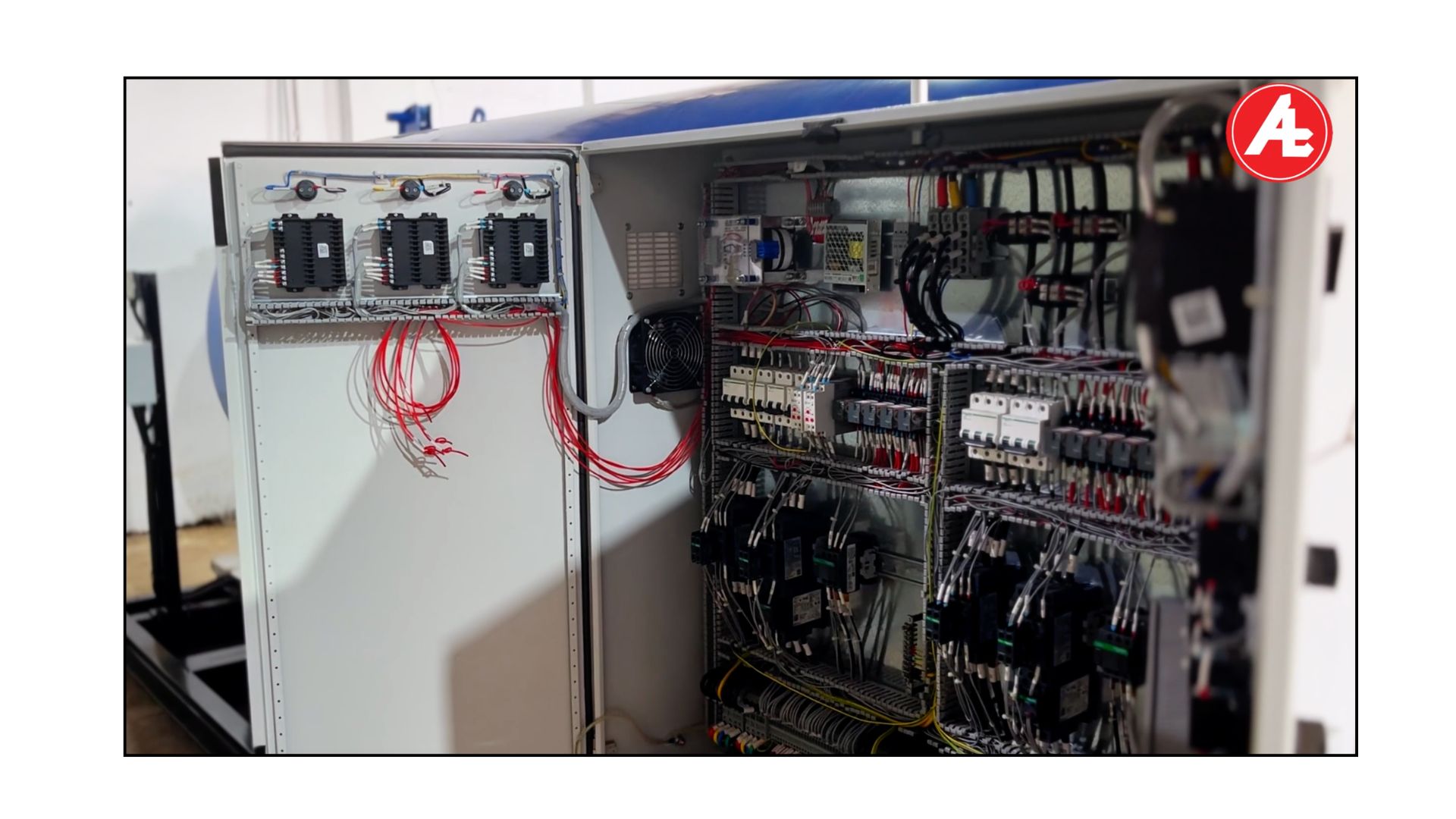
At Atmax Filtration, we understand that reliable automation and control are at the heart of every high-performance industrial Process, Heating ventilation and filtration system. Our Industrial Control Panels (ICPs) are custom-designed to ensure safety, efficiency, and seamless operation of dust collectors, industrial fans, scrubbers, and complete process ventilation setups. SCADA via Modbus or Ethernet/IP/ BACNet, Custom VFD panels and MCCs for industrial pumps and fans to reduce energy consumption and mechanical stress with soft-start technology. So whether it is your VFD from Allen-Bradley PowerFlex™, Siemens SINAMICS™or Schneider Electric Altivar™ along with Enclosures complying to Schneider Electric Altivar™ along with Enclsoures rated for appropriate NEMA.
Advanced Industrial Automation & Integrated Control Systems
The Intelligence Behind the Power In modern industrial processing, the mechanical equipment is only as reliable as the code that controls it. Atmax Filtration provides comprehensive Industrial Automation Solutions, specializing in custom PLC (Programmable Logic Controller) panels that serve as the “brain” for your thermal and airflow systems. Our automation philosophy centers on three pillars: Operator Safety, Process Stability, and Predictive Reliability.
PLC Platforms & Hardware Integration
We are platform-agnostic, meaning we engineer the solution using the hardware that best fits your plant’s existing standards:
- Allen-Bradley (Rockwell Automation):CompactLogix™ and ControlLogix™ for complex, high-speed data environments.
- Siemens:S7-1200 and S7-1500 series for robust, globally recognized industrial logic.
- Schneider Electric: Modicon™ systems for seamless integration in chemical and power sectors.
- VFD Integration: We utilize Variable Frequency Drives to optimize motor performance for pumps and fans, reducing inrush current and mechanical wear.
HMI & SCADA: Real-Time Visualization
We transform complex process data into intuitive, actionable visuals for your operators:
- Custom HMI Design:High-resolution touchscreens with “At-a-Glance” status indicators, First-Out fault detection, and multi-level security access.
- Plant-Wide SCADA:Centralized monitoring via Ignition™, Wonderware™, or FactoryTalk™. Our systems allow you to monitor multiple heaters, exchangers, and dust collectors from a single control room.
- Remote Connectivity: Secure VPN access for remote troubleshooting, allowing ATMAX engineers to support your team anywhere in the world from Texas to the UAE.
AI-Powered Predictive Maintenance
Atmax is a leader in integrating Artificial Intelligence into standard industrial logic. Our “Smart Panel” upgrade moves your facility from reactive maintenance to proactive intelligence:
- Anomaly Detection: Machine learning algorithms monitor motor vibration, current draw, and temperature drifts.
- Early Warning Logic: The system identifies a failing bearing or a scaling heat exchanger weeks before a trip occurs.
- Optimization: The AI continuously tunes PID loops and burner ratios to ensure the system is always running at the lowest possible fuel/power consumption.
Automation Components & Fieldbus Protocols
We ensure total compatibility with your plant’s digital backbone:
- Protocols: Modbus TCP/IP, Ethernet/IP, Profinet, and BACnet.
- Instrumentation:Integration of 4-20mA, HART-compliant, and digital sensors for pressure, flow, and temperature.
- Safety Interlocks:Hard-wired E-Stops combined with SIL-rated safety logic for maximum personnel protection.
VFD & MOTOR CONTROL CENTERS (MCC)
Precision Control Over Your Facility’s Power In any industrial plant, motors driving pumps, fans, and compressors are the largest consumers of electrical energy. Atmax Filtration engineers custom Motor Control Centers (MCC) and VFD Control Panels that do more than just start and stop motors they provide intelligent speed modulation, protect your mechanical infrastructure, and drastically reduce operational costs. By aligning motor output with real-time process demand, we transform “dumb” mechanical assets into “smart” energy-efficient systems.
Advanced VFD Integration & Hardware Mastery
We don’t believe in a one-size-fits-all approach. Atmax integrates the world’s leading drive technologies into custom-engineered enclosures designed for the specific environment of your plant:
- Allen-Bradley PowerFlex™: Seamless integration with Rockwell architectures for high-performance torque control and safety.
- Siemens SINAMICS™: Robust, globally-supported drives ideal for heavy-duty industrial applications and complex motion.
- Schneider Electric Altivar™:Specialized drives for pumping and ventilation with built-in energy monitoring and eco-friendly modes.
Energy Optimization: From Fixed Speed to Intelligent FlowTraditional “across-the-line” starters run motors at 100% speed, even when the process only requires 50% flow. Atmax VFD systems change the math:
- The Affinity Laws:Reducing a fan or pump speed by just 20% can reduce energy consumption by up to 50%.
- Demand-Based Control:Our PLC logic monitors sensors (pressure, temperature, or flow) and adjusts the VFD frequency in real-time, ensuring the motor only uses the exact amount of power required.
- Carbon Footprint Reduction:Improved efficiency directly translates to lower CO2 emissions, supporting your facility’s sustainability goals.
Soft-Start Technology & Mechanical Longevity
One of the greatest causes of equipment failure is the “thermal and mechanical shock” of a sudden start.
- Eliminating Inrush Current: A standard motor start can pull 600-800% of its full-load current. Our VFDs and Soft-Starters provide a “ramped” start, keeping current low and protecting your plant’s electrical grid.
- Preventing Water Hammer: By gradually ramping pump speeds, we eliminate the pressure surges (water hammer) that rupture pipes, damage valves, and fatigue welds in thermal loops.
- Extended Belt and Bearing Life: Smooth acceleration reduces the “snap” on belts and the torque-stress on motor bearings and couplings.
Power Quality & Harmonic Mitigation
High-power electronic drives can introduce “electrical noise” or harmonics into your facility’s power system, which can overheat transformers and interfere with sensitive electronics.
- Integrated Line Reactors: We install input reactors as standard to dampen transient surges.
- Harmonic Filters: For sensitive environments (Pharma/Data Centers), we provide Active or Passive Harmonic Filters to ensure compliance with IEEE 519
- EMC/RMI Shielding: Specialized cabling and grounding techniques to prevent electromagnetic interference with your plant’s instrumentation and SCADA signals.
Smart Monitoring & AI-Ready Control
Our MCCs are “Communication-Ready,” allowing for deep integration into your plant’s digital backbone:
- Fieldbus Protocols:Full support for EtherNet/IP, Modbus TCP, and Profinet.
- Predictive Maintenance: The VFD tracks parameters like motor torque, DC bus voltage, and heat sink temperature. Our AI-driven logic analyzes this data to predict an impending motor winding failure or a dry-running pump.
- Safety First: Integrated Safe Torque Off (STO) functionality ensures that motors are brought to a safe state during an emergency stop without the need for bulky external contactors
Atmax is a leader in integrating Artificial Intelligence into standard industrial logic. Our “Smart Panel” upgrade moves your facility from reactive maintenance to proactive intelligence:
- Anomaly Detection: Machine learning algorithms monitor motor vibration, current draw, and temperature drifts.
- Early Warning Logic: The system identifies a failing bearing or a scaling heat exchanger weeks before a trip occurs.
- Optimization: The AI continuously tunes PID loops and burner ratios to ensure the system is always running at the lowest possible fuel/power consumption.
Automation Components & Fieldbus Protocols
We ensure total compatibility with your plant’s digital backbone:
- Protocols: Modbus TCP/IP, Ethernet/IP, Profinet, and BACnet.
- Instrumentation:Integration of 4-20mA, HART-compliant, and digital sensors for pressure, flow, and temperature.
- Safety Interlocks:Hard-wired E-Stops combined with SIL-rated safety logic for maximum personnel protection.
VFD & MOTOR CONTROL CENTERS (MCC)
Precision Control Over Your Facility’s Power In any industrial plant, motors driving pumps, fans, and compressors are the largest consumers of electrical energy. Atmax Filtration engineers custom Motor Control Centers (MCC) and VFD Control Panels that do more than just start and stop motors they provide intelligent speed modulation, protect your mechanical infrastructure, and drastically reduce operational costs. By aligning motor output with real-time process demand, we transform “dumb” mechanical assets into “smart” energy-efficient systems.
Advanced VFD Integration & Hardware Mastery
We don’t believe in a one-size-fits-all approach. Atmax integrates the world’s leading drive technologies into custom-engineered enclosures designed for the specific environment of your plant:
- Allen-Bradley PowerFlex™: Seamless integration with Rockwell architectures for high-performance torque control and safety.
- Siemens SINAMICS™: Robust, globally-supported drives ideal for heavy-duty industrial applications and complex motion.
- Schneider Electric Altivar™:Specialized drives for pumping and ventilation with built-in energy monitoring and eco-friendly modes.
Energy Optimization: From Fixed Speed to Intelligent FlowTraditional “across-the-line” starters run motors at 100% speed, even when the process only requires 50% flow. Atmax VFD systems change the math:
- The Affinity Laws:Reducing a fan or pump speed by just 20% can reduce energy consumption by up to 50%.
- Demand-Based Control:Our PLC logic monitors sensors (pressure, temperature, or flow) and adjusts the VFD frequency in real-time, ensuring the motor only uses the exact amount of power required.
- Carbon Footprint Reduction:Improved efficiency directly translates to lower CO2 emissions, supporting your facility’s sustainability goals.
Soft-Start Technology & Mechanical Longevity
One of the greatest causes of equipment failure is the “thermal and mechanical shock” of a sudden start.
- Eliminating Inrush Current: A standard motor start can pull 600-800% of its full-load current. Our VFDs and Soft-Starters provide a “ramped” start, keeping current low and protecting your plant’s electrical grid.
- Preventing Water Hammer: By gradually ramping pump speeds, we eliminate the pressure surges (water hammer) that rupture pipes, damage valves, and fatigue welds in thermal loops.
- Extended Belt and Bearing Life: Smooth acceleration reduces the “snap” on belts and the torque-stress on motor bearings and couplings.
Power Quality & Harmonic Mitigation
High-power electronic drives can introduce “electrical noise” or harmonics into your facility’s power system, which can overheat transformers and interfere with sensitive electronics.
- Integrated Line Reactors: We install input reactors as standard to dampen transient surges.
- Harmonic Filters: For sensitive environments (Pharma/Data Centers), we provide Active or Passive Harmonic Filters to ensure compliance with IEEE 519
- EMC/RMI Shielding: Specialized cabling and grounding techniques to prevent electromagnetic interference with your plant’s instrumentation and SCADA signals.
Smart Monitoring & AI-Ready Control
Our MCCs are “Communication-Ready,” allowing for deep integration into your plant’s digital backbone:
- Fieldbus Protocols:Full support for EtherNet/IP, Modbus TCP, and Profinet.
- Predictive Maintenance: The VFD tracks parameters like motor torque, DC bus voltage, and heat sink temperature. Our AI-driven logic analyzes this data to predict an impending motor winding failure or a dry-running pump.
- Safety First: Integrated Safe Torque Off (STO) functionality ensures that motors are brought to a safe state during an emergency stop without the need for bulky external contactors
INDUSTRIAL AUTOMATION, SCADA & HMI SYSTEMS
The Digital Nerve Center of Your Facility In complex industrial environments, the ability to visualize data and respond to process changes in real-time is the difference between a high-efficiency plant and a costly shutdown. Atmax Filtration provides comprehensive Industrial Automation services, specializing in the design and programming of SCADA (Supervisory Control and Data Acquisition) and HMI (Human Machine Interface) systems. We bridge the gap between heavy mechanical hardware and digital intelligence.
Process Visualization & HMI Design
We transform thousands of data points into intuitive, high-resolution visual interfaces. Our HMI designs focus on Situational Awareness, ensuring operators can identify issues instantly.
- Custom Interface Development: Tailored screens for Allen-Bradley FactoryTalk™, Siemens WinCC™, and Schneider Magelis™.
- First-Out Fault Tracking: We program specific logic that captures the exact sequence of events during a system trip. Instead of guessing, your operator sees exactly which safety limit (e.g., “Low Flow” or “High Exhaust Temp”) triggered the shutdown.
- Real-Time Trending: Live graphs for temperature, pressure, and flow rates allow operators to see process drifts before they exceed alarm limits.
SCADA Systems: Centralized Plant Intelligence
For facilities managing multiple heaters, heat exchangers, and ventilation systems, a centralized SCADA System is essential. Atmax specializes in modern, web-based SCADA platforms like Ignition™, as well as traditional enterprise solutions.
- Unified Control: Monitor your entire thermal loop, fuel trains, and dust collection systems from a single central control room or mobile tablet.
- Historical Data Logging: Every variable is stored in a secure SQL database. This data is critical for Regulatory Compliance, Energy Audits, and Quality Assurance in sectors like Pharma and Food/Dairy.
- Alarm Management: Sophisticated alarm hierarchies that send SMS or email notifications to maintenance teams based on the severity of the event.
Advanced Programming & Logic Integration
Our engineering team writes robust, “clean” code that is easy for your plant electricians to follow and maintain.
- PID Loop Tuning: Expert configuration of Proportional-Integral-Derivative (PID) loops for precise temperature control. We eliminate “hunting” and oscillations, ensuring a rock-steady thermal process.
- Open Communication Protocols: We ensure your ATMAX skid talks to the rest of the plant using EtherNet/IP, Modbus TCP, Profinet, or BACnet.
- Safety Logic: SIL-rated programming for Burner Management Systems (BMS) and Explosion Suppression systems, ensuring safety logic is never bypassed by standard operations.
Remote Support & The “Connected” Plant
In a global economy, expert support shouldn’t depend on a flight schedule.
- Secure Remote Access: Using industrial VPN routers (e.g., eWON or Tosibox), ATMAX engineers can provide real-time troubleshooting, code updates, and diagnostic support from our hubs in Houston or the Middle East directly to your site.
- AI Integration Ready: Our SCADA architectures are built to be “AI-Ready.” We structure your data so that machine learning algorithms can analyze it to predict pump failures, heat exchanger fouling, or burner efficiency drops.
Why Choose ATMAX for Automation?
- Single-Source Logic: We design the thermal system and the code. This prevents the “vendor gap” where the programmer doesn’t understand the mechanical limitations of the heater.
- User-Centric Design: We build HMIs for operators, not just engineers. Simple, clear, and responsive.
- Scalability: Start with a single heater HMI and expand to a full-plant SCADA as your facility grows.
Looking to upgrade your industrial ventilation system with a reliable and energy-efficient control panel?
Contact Atmax Filtration today and let our experts design the right solution for your process.
Frequently Asked Questions
PLC, DCS, and SCADA serve different purposes in industrial automation. A PLC is generally used for machine control, sequencing, interlocks, and fast discrete or process applications. A DCS is designed for large, continuous processes where centralized process control, redundancy, and extensive instrumentation are important. SCADA is primarily a supervisory monitoring and data acquisition system that provides operators with real-time process information, alarms, trends, and reports.
For a machine or standalone production line, a PLC-based automation system may be the most practical choice. For large continuous-process plants, a DCS may be more suitable, while SCADA is often used to monitor and manage multiple PLCs and plant systems.
Selecting the right PLC depends on the number of I/O points, process complexity, communication requirements, processing speed, expansion requirements, and environmental conditions.
Before selecting a PLC, consider the number and type of digital and analog inputs/outputs, required communication protocols, programming requirements, available expansion modules, safety requirements, and future capacity. The PLC should also have sufficient processing capability and memory for the intended application.
For a new industrial automation project, it is advisable to provide adequate spare I/O capacity so the system can accommodate future modifications without a complete hardware replacement.
The ROI of industrial automation can be calculated by comparing the initial automation investment with the annual savings generated by the system.
Typical savings can come from reduced manpower requirements, lower energy consumption, improved production output, reduced scrap, fewer process errors, lower maintenance costs, and reduced downtime.
A basic calculation is:
Automation ROI = (Annual Financial Benefit − Annual Automation Cost) ÷ Initial Investment × 100
For a more realistic evaluation, plant managers should also consider production losses caused by downtime, quality improvements, maintenance savings, and the expected operating life of the automation system.
An industrial automation specification should clearly define the process requirements, control philosophy, equipment details, I/O list, instrumentation, PLC requirements, HMI/SCADA requirements, communication protocols, control panels, safety functions, testing, commissioning, and documentation.
It should also specify applicable standards, environmental conditions, power supply requirements, networking architecture, alarm philosophy, data logging requirements, spare capacity, and future expansion requirements.
A detailed specification helps plant teams compare automation quotations accurately and avoid costly scope gaps during installation and commissioning.
When comparing automation system integrators, look beyond the initial quotation. Evaluate their experience with similar industrial applications, technical capability, PLC/SCADA expertise, engineering resources, commissioning support, documentation, and after-sales service.
Ask potential integrators for references from similar plants and review their approach to FAT, SAT, troubleshooting, system backup, cybersecurity, and future expansion.
The lowest automation project quotation is not necessarily the lowest overall cost. A reliable integrator can reduce commissioning delays, production downtime, integration problems, and long-term maintenance issues
The cost of an industrial automation system depends on the process complexity, number of I/O points, PLC and HMI requirements, SCADA system, instrumentation, control panels, communication network, safety systems, engineering, installation, and commissioning.
A small machine automation project can be significantly less expensive than a complete plant-wide control system.
For accurate budgeting, the automation vendor should receive the process description, equipment list, I/O requirements, control philosophy, instrumentation details, and integration requirements before preparing a quotation.
A legacy PLC upgrade should be planned around the plant’s production schedule to minimize downtime. The process generally starts with documenting the existing PLC program, I/O, wiring, communication networks, field instruments, and control philosophy.
Where possible, the new PLC hardware and software can be prepared, tested, and simulated before the shutdown. A detailed migration plan, pre-commissioning checks, backup strategy, and defined rollback procedure can further reduce production risk.
For critical processes, a phased PLC migration may be preferable to replacing the entire control system in a single shutdown.
Industrial automation can improve energy efficiency by continuously monitoring and controlling motors, pumps, fans, compressors, boilers, HVAC systems, process heaters, and other utility equipment.
Automation systems can identify abnormal energy consumption, optimize equipment operating schedules, control variable-speed drives, maintain process parameters, and prevent unnecessary equipment operation.
By connecting energy meters and utility equipment to PLC or SCADA systems, plant engineers can monitor energy consumption in real time and identify areas where energy is being wasted.
Alarms, interlocks, and trips should be designed based on process risks, equipment protection requirements, operating limits, and potential failure conditions.
An alarm alerts the operator that a process parameter requires attention. An interlock prevents a particular operation from occurring unless predefined conditions are satisfied. A trip automatically stops equipment or a process when a critical limit is reached.
Good control-system design should avoid excessive alarms while ensuring that critical process conditions and equipment protection functions receive immediate attention.
Critical PLC spare parts typically include CPU modules, digital and analog I/O modules, communication modules, power supplies, relays, fuses, network components, HMI components, and other application-specific hardware.
The recommended spare inventory depends on equipment criticality, availability of replacement parts, supplier lead time, and the consequences of a control-system failure.
For older PLC systems, plant managers should pay particular attention to obsolescence and replacement lead times, as discontinued components can create significant downtime risks.
An HMI (Human-Machine Interface) allows operators to monitor and control industrial equipment through a graphical interface. It can display parameters such as temperature, pressure, flow, motor status, production data, alarms, and equipment operating conditions.
A well-designed HMI gives operators a clear view of the process and allows them to respond quickly to abnormal conditions without navigating through complicated control screens.
Integrating Variable Frequency Drives (VFDs) with a PLC or SCADA system allows the speed of motors, fans, pumps, and other rotating equipment to be adjusted according to process demand.
Instead of running equipment continuously at full speed, the control system can adjust speed based on pressure, flow, temperature, or other process requirements. This can improve process control and, in applications such as centrifugal fans and pumps, significantly reduce energy consumption.
In open-loop control, the system operates without continuously measuring the result of the process. In closed-loop control, sensors measure the actual process condition and the controller adjusts the equipment based on the difference between the actual and desired values.
For example, a closed-loop temperature control system can continuously measure temperature and adjust a heating element or control valve to maintain the required setpoint.
Closed-loop control is widely used where accurate and stable process control is required.
Yes. Automation systems can monitor electricity, compressed air, steam, water, chilled water, fuel, and other plant utilities by integrating energy meters, flow meters, pressure transmitters, and other instrumentation with PLC or SCADA systems.
Utility managers can use this data to track consumption by production line, department, or equipment and identify abnormal usage, leaks, inefficient operation, and peak-demand issues.
PID (Proportional-Integral-Derivative) control is a feedback control method used to maintain a process variable close to a desired setpoint. The controller continuously compares the actual value with the setpoint and adjusts the output accordingly.
PID control is commonly used for temperature, pressure, flow, level, speed, and other process parameters. For example, a PID controller can regulate a control valve to maintain steam pressure or adjust a VFD to maintain a required airflow or process pressure.
Proper PID tuning is important because poorly tuned parameters can cause process instability, excessive oscillation, slow response, or unnecessary energy consumption.
The right level of automation depends on process complexity, production volume, safety requirements, labour requirements, quality targets, energy consumption, equipment reliability, and expected return on investment.
Start by identifying processes that involve repetitive operations, significant manual intervention, frequent errors, high energy consumption, safety risks, or production bottlenecks.
Automation does not always mean fully automatic operation. A partially automated or semi-automatic system may provide better ROI than complete automation for certain processes.
A PLC-based control system is often suitable for machine automation, production lines, material handling systems, utility equipment, packaged systems, and applications where fast discrete control and sequencing are important.
A DCS may be more appropriate for large continuous-process plants with extensive instrumentation, numerous control loops, centralized process management, and high availability requirements.
The decision should consider process type, number of control loops, I/O requirements, redundancy, scalability, operator requirements, integration needs, and total lifecycle cost rather than simply comparing PLC and DCS prices.
The inspection frequency depends on the operating environment, panel design, equipment criticality, temperature, humidity, dust levels, vibration, and manufacturer recommendations.
A routine inspection should check for loose connections, overheating, dust accumulation, corrosion, damaged wiring, cooling-system problems, abnormal noise, and signs of component deterioration.
For critical industrial automation systems, plants should establish a preventive maintenance schedule and periodically inspect PLCs, power supplies, communication equipment, VFDs, cooling systems, terminals, and electrical protection devices.
Plants should maintain multiple, verified backups of PLC programs, HMI applications, SCADA projects, PLC configurations, network configurations, and other critical automation files.
A practical backup strategy should include:
- A current working backup
- A backup stored separately from the control system
- Version-controlled copies after major modifications
- Secure offline or protected backups
- Documented restoration procedures
- Periodic testing to confirm that backups can actually be restored
Backup files should also be protected from unauthorized modification. A backup that has never been tested is not a reliable recovery strategy.
The applicable standards depend on the industry, process, equipment, location, and safety requirements. Common standards and frameworks considered in industrial automation projects include IEC 61131 for programmable controllers, IEC 61508 for functional safety, IEC 61511 for safety instrumented systems in the process industry, and IEC 62443 for industrial automation and control system cybersecurity.
Other requirements may apply depending on the project, such as electrical installation standards, machinery safety requirements, hazardous-area classifications, and industry-specific regulations.
The automation specification should clearly identify the applicable standards and compliance requirements before system design and procurement begin.
Download Brochure
Let’s Start Work Together
- 2101 Park Ave, South Plainfield New Jersey 07080, USA
- sales@atmaxfiltration.com
- (816) 745-9994
- Mon – Fri : 8:00 AM to 7:00 PM
INDUSTRIAL AUTOMATION, SCADA & HMI SYSTEMS
INDUSTRIAL AUTOMATION, SCADA & HMI SYSTEMS
Atmax Filtration provides high quality dust collectors and accessories and supplies in the entire New Jersey.
For more information talk to us on (816)-745-9994 or write at sales@atmaxfiltration.com