
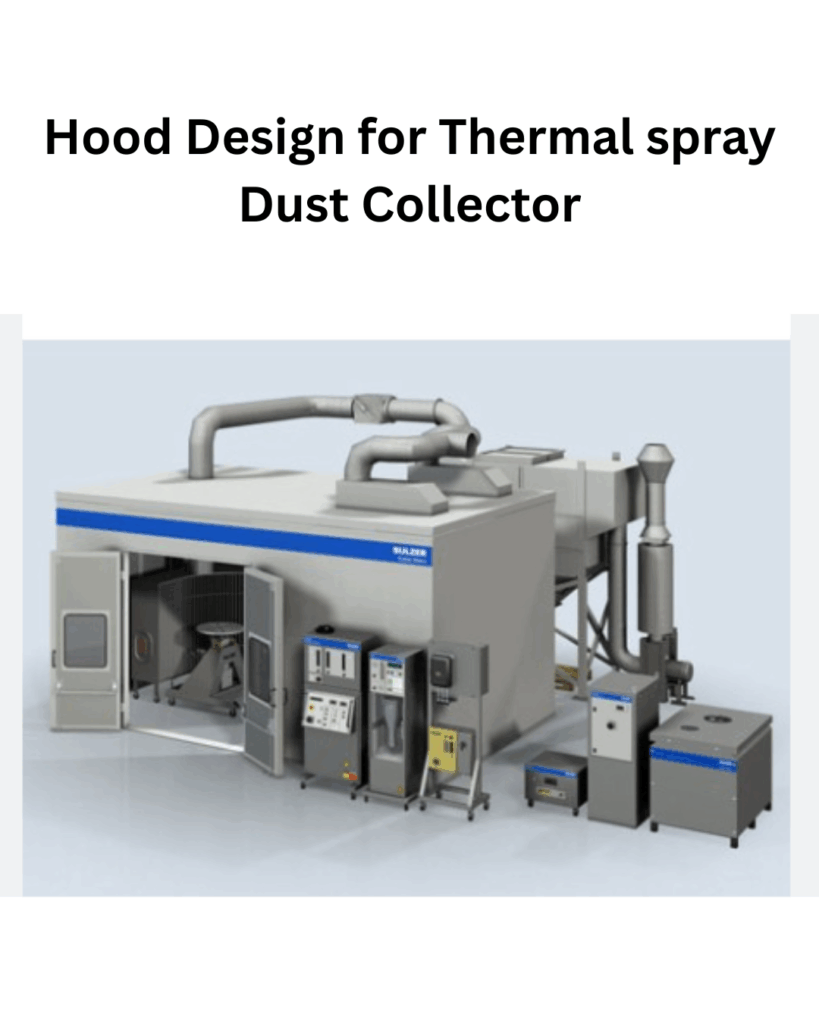
Thermal spray processes whether using plasma, HVOF, or flame spray generate a fine mist of overspray and dust that can quickly contaminate the work environment if not properly managed. A dust collection system is essential to maintaining air quality, but even the best collector can only capture the dust that actually reaches it.
At Atmax Filtration, we’ve found that the real key to effective dust control lies not only in the filtration equipment but also in the hood and airflow design that supports it. Without optimized airflow, overspray can linger in the booth, affect coating consistency, and pose health and fire hazards.
Let’s explore how proper airflow planning and hood design can make or break the performance of a thermal spray dust collection system.
The Role of Airflow in Thermal Spray Dust Collection
A thermal spray ventilation system typically consists of
- Capture hoods or plenums positioned near the spray zone
- Ductwork transporting dust-laden air
- A fan and dust collector maintaining negative pressure
Many facilities assume increasing airflow volume will automatically improve dust capture. However, simply moving more air is not the answer — excessive airflow can disrupt the spray stream, waste energy, and even re-entrain dust.
Atmax Filtration’s design approach focuses on intelligent airflow management: strategically positioning hoods, optimizing duct sizing, and aligning makeup air with the spray direction to efficiently capture airborne particulate at its source.
The Importance of Makeup Air Balance
For every cubic foot of dirty air removed by the dust collector, an equal volume of makeup air must be introduced back into the booth. Without this balance, negative or positive pressure imbalances can disrupt the spray process.
Makeup air can be supplied:
- Through natural openings in the booth structure
- Via a dedicated makeup air unit, which delivers conditioned air directly to the booth
Maintaining a slight negative pressure inside the booth is ideal — it prevents fugitive dust from escaping into surrounding areas. However, during filter pulse-cleaning cycles, the short bursts of reverse air can momentarily increase booth pressure. If the design isn’t correct, this pressure spike could pop open access doors or trip safety limit switches, causing unnecessary production downtime.
Atmax Filtration’s engineers account for these fluctuations during system design to ensure stable operating pressure throughout the spray process.
Cross-Ventilation for Efficient Airflow
A well-planned cross-ventilation pattern where makeup air enters from one side and exits on the opposite ensures consistent airflow across the booth. This helps sweep airborne dust toward the exhaust plenum and prevents localized accumulation.
Installing makeup air ducts on top of the booth with sound attenuators (silencers) can help achieve smooth, quiet airflow distribution without disturbing the thermal spray process.
Our team at Atmax Filtration often uses Computational Fluid Dynamics (CFD) analysis to visualize air movement inside spray cells, ensuring clean, laminar airflow and maximum contaminant capture efficiency.
4. Downward vs. Horizontal Airflow Design
Different thermal spray processes call for different airflow configurations. The two most common are downward and horizontal (cross-flow) designs.
a. Downward Airflow Pattern
In a downflow booth, air is drawn from the ceiling downward through a grated floor into an underfloor plenum, and then exhausted to the dust collector.
Advantages:
- Gravity aids in removing contaminants
- Keeps the operator’s breathing zone cleaner
- Excellent for high-volume overspray applications
Challenges:
- The plenum must maintain an air velocity above 2,500 feet per minute (fpm) to prevent dust from settling
- Requires significant vertical space or a pit installation
- More complex to clean and maintain
Atmax Filtration ensures proper plenum velocity and duct balancing to avoid dust accumulation and maintain high system efficiency.
b. Horizontal Airflow Pattern
A horizontal (cross-flow) design pulls contaminated air laterally across the booth, with the exhaust plenum located behind the spray target.
Advantages:
- Smaller hoods provide targeted capture directly at the source
- Requires less overall air volume than downflow systems
- Easier to retrofit into existing facilities
This approach is widely used in aerospace and turbine component spraying, where precise control of overspray is essential for coating quality.
Atmax Filtration engineers design horizontal flow systems to create task-focused air movement that minimizes air volume requirements while maximizing capture efficiency.
Design Best Practices for Thermal Spray Dust Collection
To ensure reliable performance and operator safety, Atmax Filtration recommends the following best practices for designing and maintaining your thermal spray ventilation system:
✅ Analyze booth geometry — Align airflow with spray direction and target location.
✅ Maintain proper air balance — Slight negative pressure prevents dust leakage.
✅ Prevent turbulence — Smooth airflow paths protect spray quality.
✅ Use CFD or smoke visualization testing — Validate real-world airflow efficiency.
✅ Ensure high plenum velocity — Avoid dust buildup in underfloor plenums.
✅ Schedule periodic cleaning and maintenance — Keep ducts, hoods, and filters clear.
✅ Consult experienced ventilation engineers — Proper design saves energy and downtime.
Final Thoughts
Optimizing hood and airflow design is the foundation of effective thermal spray dust collection. The right combination of booth layout, makeup air control, and exhaust strategy ensures cleaner air, improved coating quality, and enhanced operator safety.
Atmax Filtration’s holistic approach combining engineering expertise, system design, and field experience helps industrial facilities achieve superior air quality and operational efficiency.