
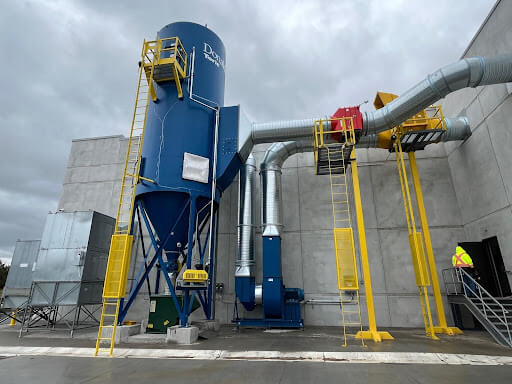
At Atmax Filtration, we know from hands-on field experience that effective dust collection is never just about installing a collector, it’s about understanding the complete operating environment. In demanding industrial applications, dust behavior, gas stream conditions, and process chemistry must all be evaluated together to design systems that perform reliably over the long term.
Selecting the Right Dust Collector
Every successful dust collection system begins with a clear understanding of the dust being generated. Key questions our engineers routinely evaluate include:
- Is the dust fine, ultra-fine, or a mix of particle sizes?
- Is it abrasive or friable?
- Is it hygroscopic or moisture-sensitive?
- Does it agglomerate easily or resist agglomeration?
- Is it combustible or explosive?
- Is it corrosive, toxic, or chemically unstable?
Each of these factors directly impacts collector type, filter media selection, air-to-media ratio, and maintenance strategy.
Why Gas Stream Characteristics Are Equally Critical
While dust properties are important, Atmax Filtration often finds that gas stream conditions have an even greater influence on dust collector performance than the dust itself.
Real-world industrial processes whether in manufacturing, chemicals, power plants, or material handling rarely involve “clean” air. Temperature, moisture, and chemical composition interact with dust in complex ways, often creating unexpected challenges if not addressed during the design phase.
Gas Stream Temperature: Designing Beyond Media Limits
Elevated temperatures affect far more than filter media selection. At Atmax Filtration, temperature considerations influence:
- Bag vs. cartridge collector selection
- Filter cleaning mechanism effectiveness
- Collector housing materials
- Gaskets, coatings, and seals
- Required filtration velocity and filter area
Higher temperatures typically require more conservative air-to-media ratios, increasing collector size to maintain stable pressure drop and efficient cleaning.
Temperature constraints also limit media options. For example, fiberglass media may tolerate heat but is unsuitable for certain pulse-jet configurations, while spunbond polyester may fail in shaker-style collectors. These realities often determine the most practical collector design early in the process.
Materials of Construction & Thermal Protection
Challenging gas streams may require specialized construction materials, corrosion-resistant coatings, and thermal insulation. Insulation is not only about energy efficiency, it is often critical for:
- Preventing moisture and acid condensation
- Protecting personnel
- Ensuring consistent system performance
Atmax Filtration evaluates these requirements holistically to ensure durability in harsh operating conditions.
Air Volume, Velocity, and Density Considerations
As gas temperature increases, density decreases and total air volume rises. This directly affects filtration velocity and collector sizing. Failure to account for these changes can lead to undersized systems, elevated pressure drop, and poor dust capture efficiency.
Moisture: One of the Most Common Failure Triggers
Moisture is a frequent cause of dust collection problems across industrial facilities.
Condensation and Mud Formation
When moisture condenses on filter media or internal collector surfaces, dust can form mud nearly impossible to remove using normal pulse cleaning or shaking. Airflow becomes restricted, filters blind rapidly, and system performance declines.
Maintaining internal temperatures above moisture and acid dew points is essential for reliable operation.
Hopper Condensation: A Hidden Operational Risk
Hopper interiors are often the coldest areas of a dust collector. Even when filter media temperatures remain safe, condensation can form on hopper walls. When pulse-cleaned dust lands on wet surfaces, it becomes sticky, leading to dust buildup, bridging, and blocked discharge openings.
From Atmax Filtration’s field experience, hopper-related issues are among the most overlooked causes of unplanned shutdowns.
Proven Preventative Strategies
Depending on the application, Atmax Filtration may recommend:
- Insulating collector housings and hoppers
- Adding external hopper heaters
- Heating compressed air used for pulse cleaning
Compressed air expansion during pulsing can briefly chill internal surfaces below the dew point. In moisture-sensitive environments, heated pulse air can be critical to stable operation.
Hygroscopic Dust: When Humidity Becomes the Enemy
Dusts such as sugar, salts, and lime actively absorb moisture from the air stream even without visible condensation. As humidity rises, these dusts become sticky and difficult to release from filter media.
Best practice:
Maintain relative humidity at or below 40% RH when handling hygroscopic dusts. Hydrophobic or fluorocarbon-treated filter media can significantly improve dust release, stabilize pressure drop, and extend filter life.
Low Moisture, High Temperature, and Electrostatic Effects
Too little moisture can be just as problematic as too much.
At high temperatures and low humidity, certain dusts such as metallic salts can become electrostatically charged. Particles repel each other instead of agglomerating, preventing effective dust release and migration to the hopper.
In select applications, controlled moisture injection (often via steam) can promote agglomeration and restore system performance. These challenges are frequently identified only after startup reinforcing the importance of upfront process evaluation.
Chemical Composition of the Gas Stream
Industrial gas streams often contain acid gases, hydrocarbons, VOCs, and condensable compounds. When combined with moisture and cooling temperatures, these contaminants can form corrosive acids below their dew points.
Atmax Filtration evaluates
- Filter media chemical resistance
- Coatings and liner requirements
- Insulation strategies
- Long-term maintenance implications
In complex gas streams, tradeoffs are inevitable higher initial investment may deliver longer equipment life, fewer filter changes, and lower total cost of ownership.
Similar Processes, Very Different Solutions
Two gas streams may appear identical but behave very differently. For example, Ryton (PPS) media performs well in hot, SOx-laden boiler flue gas. However, in kiln applications with high excess air and oxygen levels above 8%, oxidative degradation can significantly reduce media life.
In such cases, polyimide (P84) media may offer better durability even with lower acid resistance. These distinctions highlight why Atmax Filtration emphasizes application-specific engineering over generic solutions.
Conclusion-
Challenging dust collection environments demand a complete understanding of the entire gas stream, not just the dust. Temperature, moisture, chemistry, and airflow dynamics must be evaluated together.
When Atmax Filtration engineers ask detailed questions about your process, it’s intentional. Our goal is to identify risks early, prevent commissioning surprises, and deliver dust collection systems that perform reliably over their full service life.
Facing challenges upfront leads to better designs, lower operating costs, and safer, cleaner industrial environments.