
Downward Draft Table
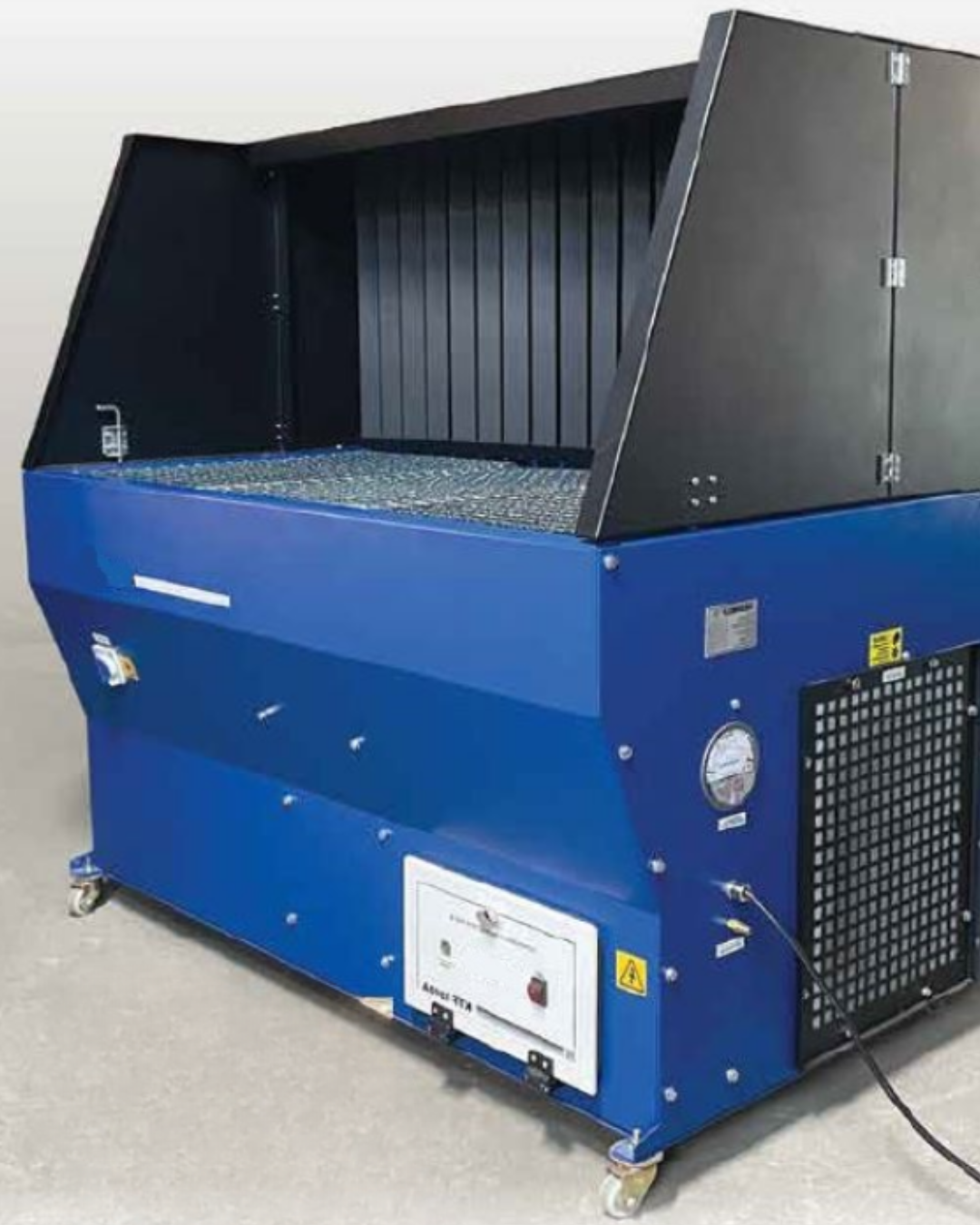
A Downward Draft Table is an industrial source-capture ventilation system designed to capture dust, fumes, smoke, and airborne particles directly at the work surface. Instead of allowing contaminants to rise into the operator’s breathing zone or disperse throughout the facility, the table draws contaminated air downward through the work surface and into an integrated or connected filtration system.
Downward Draft Tables are engineered for applications where dust and particulate generation occurs during manual processing, grinding, sanding, deburring, polishing, cutting, mixing, and other material-handling operations.
How a Downward Draft Table Works
The table creates a controlled downward airflow across the work surface. Contaminated air generated during the process is pulled through perforated or grated sections of the worktop.
The captured air then passes through the dust collection and filtration system, where particulate is separated from the airstream before the cleaned air is discharged or returned to the facility, depending on the system configuration.
Typical airflow path:
Workpiece → Downward airflow → Pre-separation/filtration → Dust collection → Clean air discharge
This source-capture approach helps control airborne contaminants near their source, reducing their migration into the surrounding workspace.
Features
- Captures dust and particulates directly at the work surface.
- Designed for demanding industrial environments.
- Engineered to provide consistent suction across the working area.
- Can be configured with suitable cartridge, bag, or other filtration systems.
- Collection systems can be equipped with accessible dust drawers, hoppers, or suitable discharge arrangements.
- Components are selected for accessibility and routine maintenance.
- Dimensions, airflow capacity, filtration, and work-surface arrangements can be engineered to suit the application.
- Helps maintain a cleaner work zone by capturing contaminants at the point of generation.
Applications
Downward Draft Tables are commonly used for operations that generate localized dust, fumes, smoke, or particulate, including
- Grinding and deburring
- Sanding and finishing
- Polishing
- Welding and metalworking applications
- Cutting and fabrication
- Composite processing
- Woodworking
- Powder handling
- Pharmaceutical and chemical processing
- Manual material processing
- Small-part finishing
- Surface preparation
The appropriate configuration depends on the material being processed, contaminant characteristics, generation rate, required airflow, workpiece dimensions, and applicable workplace requirements.
Why Use a Downward Draft Table?
Traditional general-purpose ventilation relies on moving contaminated air after it has already dispersed into the workspace. A downward draft table captures the contaminant at its source.
This can provide several operational advantages:
- Better Contaminant Control
Pulling dust and particulate downward through the work surface helps limit the amount of airborne material entering the surrounding work area.
- Improved Working Environment
Effective source capture can contribute to cleaner workstations and reduce the accumulation of airborne and settled particulate around the operator.
- Flexible Workstation Design
The table can be configured for different workpiece sizes, process requirements, airflow demands, and filtration arrangements. - Reduced Dependence on General Ventilation
Source capture complements facility-wide ventilation by controlling contaminants close to their point of generation rather than relying entirely on dilution ventilation.
Downward Draft Table Design Considerations
Selecting the right table is not simply a matter of choosing a table size. The dust collection system must be matched to the process.
Important engineering parameters include:
- Airflow:
The required CFM depends on the table dimensions, work process, contaminant characteristics, capture requirements, and airflow distribution. - Static Pressure:
The fan must provide sufficient static pressure to overcome resistance from the work surface, ductwork, filters, dampers, and other system components. - Filtration:
Filter selection depends on particle size, dust loading, material properties, temperature, moisture, and required filtration efficiency. - Work Surface:
The perforated, grated, or slotted work surface must provide sufficient open area while maintaining the required capture velocity and supporting the workpiece. - Dust Characteristics:
Combustible, abrasive, sticky, fibrous, toxic, or chemically reactive dusts may require specialized filtration and dust-handling arrangements. - Dust Disposal:
The collection section should be designed for practical and safe removal of collected material. - Explosion Protection:
Where combustible dust is present, the complete dust collection system should be evaluated for applicable fire and explosion hazards. Depending on the material and process, appropriate explosion protection and isolation measures may be required.
A Downward Draft Table is more than a ventilated workbench. It is a source-capture dust collection system designed around the interaction between the process, airflow, filtration, and dust handling.
When properly engineered, it provides controlled airflow at the point where contaminants are generated while supporting cleaner and more productive industrial work areas.
Tell us about your process, material, table dimensions, and dust characteristics. Atmax Filtration can help determine the appropriate airflow, filtration, fan capacity, and table configuration for your application.
Contact Atmax Filtration for a custom downward-draft table and dust collection solution.

Download Brochure
Let’s Start Work Together
- 2101 Park Ave, South Plainfield NJ 07080, USA South Plainfield, United States, 7080
- sales@atmaxfiltration.com
- +1-816-745-9994
- Mon – Fri : 8:00 AM to 7:00 PM
Atmax Filtration provides high quality dust collectors and accessories and supplies in the entire New Jersey.
For more information talk to us on (816)-745-9994 or write at sales@atmaxfiltration.com
No posts found!