
Efficient filter cleaning is essential to the long-term performance and operating cost of any dust collection system. Over the last several decades, the industry has shifted from basic passive filtration to advanced active cleaning technologies that significantly extend filter life, stabilize airflow, and reduce energy consumption.
This article provides a technical overview of how filter cleaning methods evolved and how modern pulse-jet and energy-shaped cleaning systems deliver superior performance for industrial operations.
From Passive Filtration to Active Cleaning Systems
Early dust collectors relied solely on passive filtration. Dust gradually accumulated on the filter media, increasing pressure drop and restricting system airflow. Once airflow dropped below acceptable levels, the collector had to be shut down so the loaded filters could be removed and replaced.
This process was labor-intensive, resulting in extended downtime and higher operating costs.
The development of active filter cleaning was a defining advancement. Instead of replacing filters when the pressure drop increased, facilities could now restore filter permeability by removing the accumulated dust cake while the filters remained in place.
Major Filter Cleaning Technologies
1. Mechanical Cleaning
Mechanical cleaning was one of the earliest active methods introduced.
Principle of operation:
Filters are physically agitated either manually or using automated mechanisms—to dislodge accumulated dust.
Types of mechanical systems:
- Manual shaking (lever or foot pedal)
- Motor-driven shakers or vibratory mechanisms
Advantages:
-Simpler technology
-Reduced filter replacement frequency
Limitations:-
-Requires airflow to be completely shut down
-Classified as intermittent duty
-Performance depends on how often cleaning cycles can be paused for operation
Mechanical cleaning improved upon passive filtration but lacked the consistency required for high-demand industrial applications.
2. Reverse Air Cleaning
Reverse air cleaning introduced cleaning airflow in the opposite direction of the filtering airflow.
Operating concept:
Low- or medium-pressure air is pushed backwards through the filter media, removing the dust cake from the outer surface.
Characteristics of reverse air cleaning:
-Often uses a fan running continuously-
-Filters are cleaned in small groups instead of all at once
-Considered continuous duty, as system airflow does not need to be stopped
-Provides more stable airflow than mechanical cleaning systems
This technology remains widely used in large baghouse collectors due to its dependable performance and ability to handle heavy dust loading.
3. Pulse-Jet Cleaning (Industry Standard)
Pulse-jet cleaning has become the most efficient and widely adopted cleaning technology in modern dust collectors.
How it works:
A short, high-energy pulse of compressed air is directed into the clean-air plenum. This pulse expands the filter media momentarily, breaking the dust cake and expelling particulate from the surface.
Typical pulse pressures:
-Medium pressure: <15 psig
-High pressure: 60–90 psig
Key advantages:
-Extremely effective dust release
-Minimal disruption to airflow
-Suitable for continuous, on-line operation
-Highly efficient for fine particulate and high dust loading
Pulse-jet systems provide consistent performance and longer filter life, making them ideal for demanding industrial environments
Advancements that Improved Pulse-Jet Cleaning Efficiency
1. Blowpipe (Jet Tube) Integration
Early pulse-jet systems simply released compressed air into the collector. Adding a blowpipe focused and directed the pulse, improving cleaning effectiveness and reducing air waste.
2. Venturi Chamber Enhancement
The addition of a venturi at the clean-air inlet significantly optimized the cleaning process.
Benefits of the venturi:
- Improves airflow acceleration during the pulse
- Directs cleaning energy more efficiently into the filter
- Enhances dust removal with lower compressed air consumption
Venturi-assisted pulse systems remain standard in high-performance collectors.
Next-Generation Cleaning: Pulse Energy Shaping and PowerCore® Technology
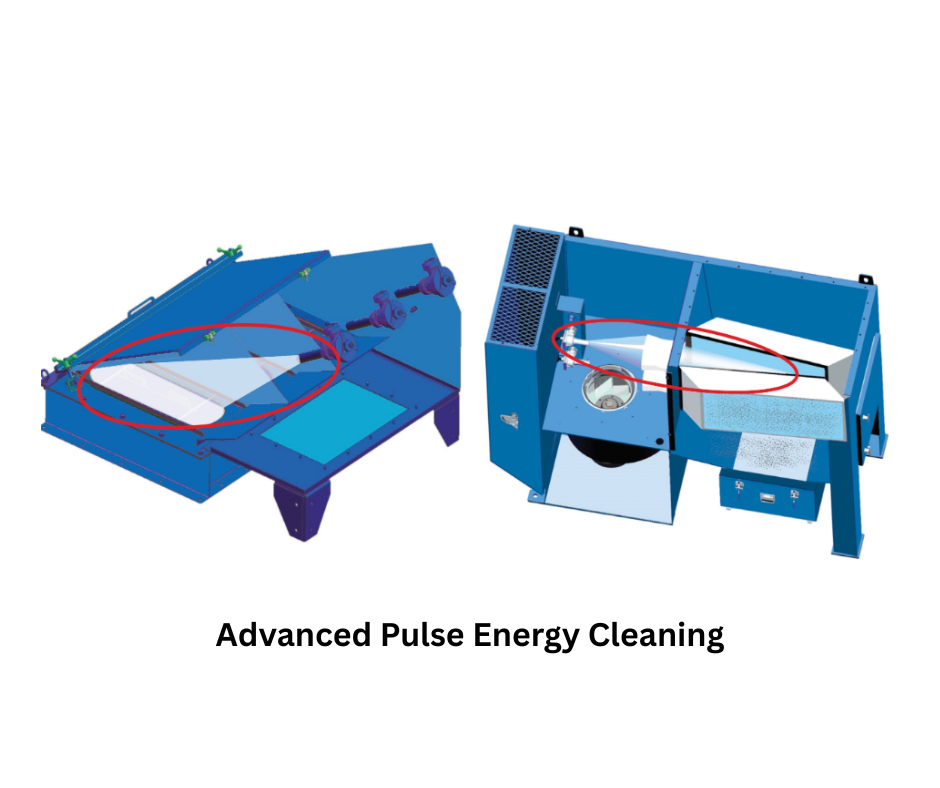
Modern filtration systems introduced further refinements to pulse cleaning, particularly with PowerCore®-style compact filter packs.
Pulse Accumulator (Energy Shaping)
This component stabilizes and shapes the compressed air pulse, ensuring consistent cleaning energy across the filter surface without restricting airflow.
Zero-Turn Pulse Design
Directs the pulse in a straight, unobstructed path into the filter media, improving dust discharge from fluted channels and enhancing recovery after heavy loading.
These innovations deliver optimized energy usage, reliable cleaning, and improved filter performance even under challenging conditions.
Continuous Duty (On-Line) Cleaning
One of the most significant benefits of modern cleaning systems is the ability to clean filters without interrupting airflow.
Depending on the design:
- Some systems cycle continuously
- Others activate based on pressure drop setpoints
- Cleaning frequency increases automatically as dust loading rises
This ensures stable system performance and maximizes operational uptime.
Why Optimized Cleaning Matters
Upgrading or fine-tuning filter cleaning technology directly influences system efficiency. Benefits include:
- Longer filter life and reduced replacement costs
- Lower energy consumption due to stabilized pressure drop
- Consistent airflow and improved process reliability
- Reduced downtime and maintenance requirements
- Enhanced overall collector performance
For facilities managing complex dust loads, optimized cleaning is crucial for safety, compliance, and long-term operational efficiency.
Conclusion
The evolution from passive filtration to advanced pulse-jet, venturi-assisted, and energy-shaped cleaning technologies has significantly strengthened the performance and reliability of modern dust collectors. These advancements help facilities maintain stable airflow, extend filter life, reduce energy consumption, and ensure safer, compliant operations across a wide range of industrial environments.
For organizations looking to evaluate, upgrade, or optimize their dust collector cleaning systems, Atmax Filtration provides the technical expertise, system design support, and high-performance filtration solutions needed to achieve consistent, long-term operational efficiency.