
Efficient dust collector placement is one of the most overlooked cost drivers in powder and bulk handling facilities. Whether you’re operating in chemicals, cement, food processing, plastics, grain, or minerals, the way your dust collectors are positioned has a direct impact on energy consumption, filter life, maintenance schedules, and overall plant uptime.
Atmax Filtration works with facilities to help streamline dust collection systems, reduce operating expenses, and improve environmental performance. Below is a refined look at the three most effective dust collector placement strategies and how choosing the right one can create measurable long-term savings.
1. Centralized Dust Collection Strategy
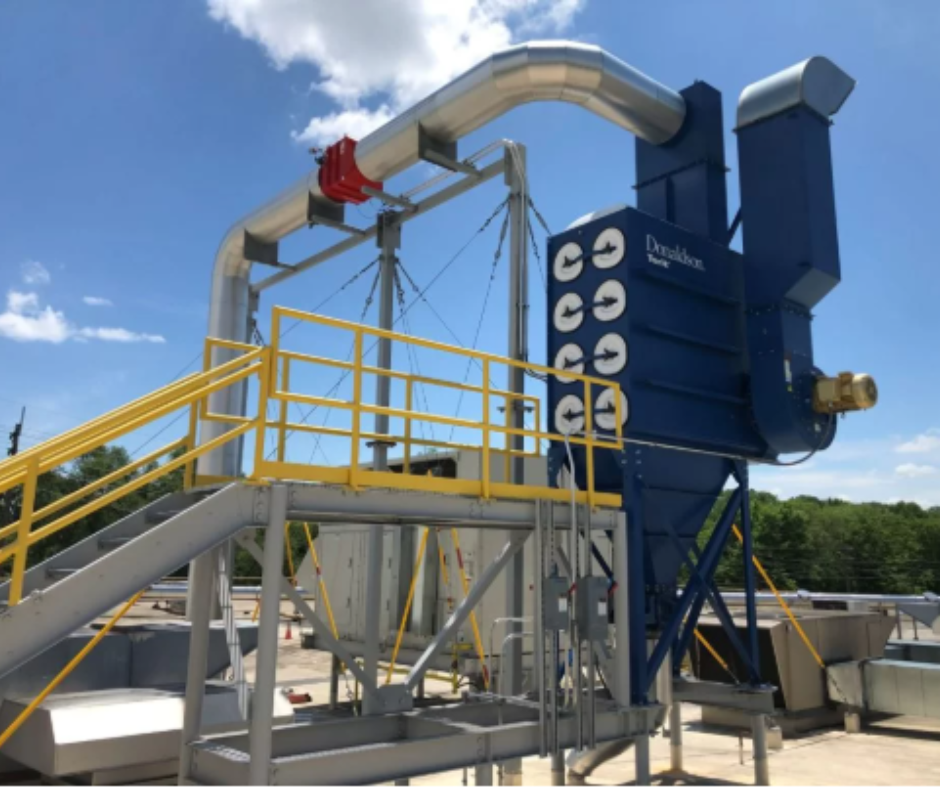
A centralized system uses a single large dust collector usually outside the building—to service multiple dust-generating points connected via ductwork.
Benefits
Minimal Footprint at Dust Sources-Only hoods are installed at the dust-generating points, helping save space around conveyors, mixers, silos, packaging lines, and other equipment where clearance is tight.
Fewer Units to Maintain-One collector means consolidated filter changes, monitoring, and controls.
Challenges
High Ducting Requirements-Long duct runs increase capital cost, installation time, static pressure, and maintenance especially with abrasive dusts.
Mixing of Incompatible Dusts-Combining different dust streams can raise risks of corrosion, fire, or explosion, and may prevent valuable product from being reclaimed.
Higher Energy Use-Fans often run at full load even when only one machine is generating dust, leading to unnecessary electrical consumption.
Centralized Shutdowns-Servicing the main collector may require shutting down large portions of production unless maintenance is scheduled during costly off-hours.
2. Dedicated Dust Collector Placement Strategy
This strategy assigns one dust collector to each process or to each group of machines handling similar materials.
Benefits
Improved Product Reclamation-Dust remains pure to its process and can often be returned to production or resold instead of being landfilled.
Localized Maintenance-Only the affected process area stops during collector servicing, not the entire facility.
Energy Savings-Fans operate only when the specific equipment or zone is active—perfect for batch processes or variable production schedules.
Challenges
More Units to Manage-More collectors and fans may appear costly at first, but many facilities find overall savings due to:
- Smaller ducts
- Shorter runs
- Lower fan horsepower
- Reduced installation time
In many cases, dedicated installations end up being cheaper than centralized systems over their lifecycle.
3. Integrated (Source) Dust Collector Strategy
Integrated or “source” collectors are mounted directly on the equipment where dust is generated eliminating ductwork entirely.
Advances in compact filtration technologies (such as high-efficiency fluted filter packs) now make this strategy feasible even in tight spaces.
Benefits
No Ducting Required-No ducts mean:
- No duct installation
- No duct maintenance
- No abrasion wear
- No costly static pressure losses
Major Energy Savings-Because no long ducts are involved, smaller fans can be used—significantly lowering power consumption.
Direct Product Return-Collected dust drops straight back into the process, eliminating:
-Conveying equipment
-Manual handling
-Disposal costs
Maintenance Flexibility-Each collector can be serviced independently without plant-wide downtime.
Lower Installation Costs-Compact designs, minimal structural requirements, and reduced freight make integrated systems highly cost-effective.
Real-World Outcomes of Integrated Strategies
Example: Abrasive Bulk Material Unloading
A multi-bay unloading facility replaced its planned central system with compact integrated collectors at each bay. The facility eliminated abrasive dust transport through ducts and significantly reduced filter purchases and electrical costs per bay.
Example: Powder Storage & Transfer Facility
A multi-silo storage plant achieved:
- Elimination of all duct losses
- Lower fan horsepower
- Over $18,000 per year in energy savings
- Easier maintenance
- No conveyors or rotary valves for dust return
Conclusion:
Dust collector placement is not a one-size-fits-all decision.
The optimal solution depends on your dust type, process layout, energy goals, maintenance capabilities, and long-term operating costs.
Atmax Filtration helps facilities evaluate and design these systems with a data-driven approach that prioritizes:
- Lower lifecycle cost
- Peak dust capture efficiency
- Energy optimization
- Minimal downtime
- Safe, compliant air quality
Whether you need a centralized upgrade, a dedicated system redesign, or integrated source collectors, Atmax delivers full support from engineering and equipment supply to installation, startup, TABB services, and maintenance.