
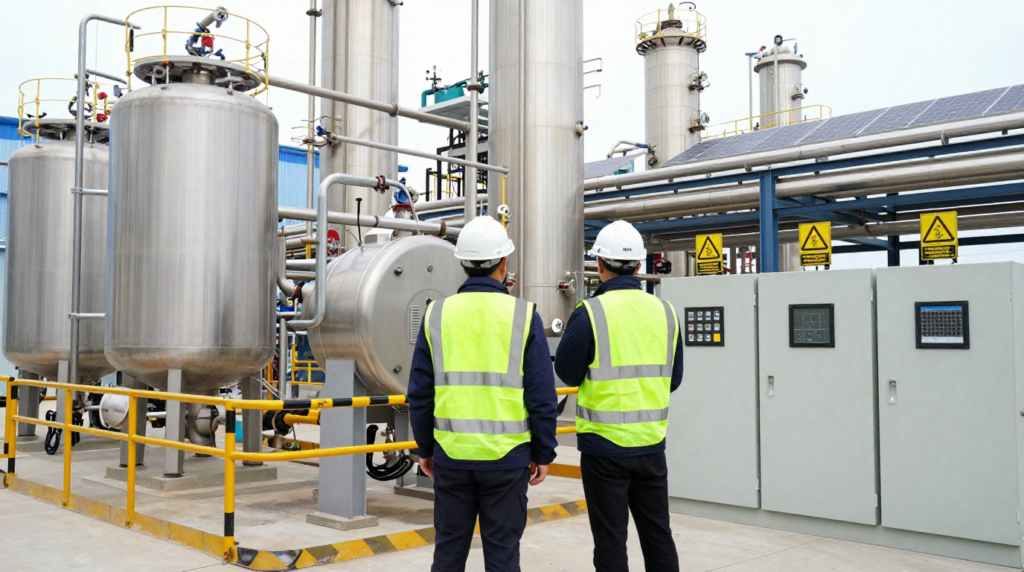
Chemical manufacturing plants operate in environments where hazardous gases, corrosive vapors, and reactive chemicals are frequently present. Ventilation systems in these facilities must do far more than simply move air, they must capture, contain, and treat contaminated air streams while ensuring safe working conditions and regulatory compliance.
Designing ventilation systems for chemical plants therefore presents several engineering challenges related to corrosion resistance, hazardous area classification, emission regulations, equipment material selection, and air pollution control systems.
Understanding these challenges is essential for maintaining safe, compliant, and reliable plant operations.
Managing Hazardous Vapors and Toxic Emissions
Chemical plants often contain zones where flammable gases or vapors may be present, requiring careful consideration of hazardous area classification during ventilation system design.
These classifications determine the type of equipment that can be safely installed in the area.
Engineering considerations include:
- Explosion-proof motors and electrical systems
- Spark-resistant fan construction
- Grounding and static control measures
- Proper airflow design to prevent vapor accumulation
Ventilation systems must be designed to maintain vapor concentrations well below their lower explosive limits (LEL), significantly reducing the risk of fires or explosions.
Corrosion Challenges in Chemical Ventilation Systems
Corrosive gases are one of the biggest threats to ventilation equipment in chemical manufacturing plants. Acid vapors, solvents, and chlorinated compounds can quickly damage improperly selected materials.
Engineers must carefully evaluate corrosion resistance when selecting fans, ducting, and ventilation equipment.
Common solutions include the use of:
- Stainless Steel fans for moderate corrosive environments
- Fiberglass or PP FRP fans for highly aggressive chemical environments
Material selection plays a critical role in determining the long-term durability of the ventilation system.
Corrosion and Material Compatibility
Chemical plants often operate in highly corrosive environments. Acids, solvents, and aggressive chemicals can rapidly degrade equipment if materials are not carefully selected.
Engineers must evaluate material compatibility with process chemicals before selecting equipment and piping systems.
Common engineering solutions include:
- Stainless steel equipment for moderate corrosion resistance
- High-alloy materials for aggressive chemical environments
- FRP and polymer-based materials for highly corrosive applications
- Protective coatings and linings
Failure to address corrosion issues can result in equipment failure, safety risks, and unplanned downtime.
Process Safety and Risk Management
Chemical manufacturing involves reactions that can generate heat, pressure, and hazardous byproducts. Improper control of these reactions can lead to catastrophic incidents.
Engineering teams must integrate process safety principles throughout plant design and operation.
Important safety considerations include:
- Hazard and operability studies (HAZOP)
- Pressure relief systems
- Explosion protection systems
- Emergency shutdown systems
- Safe process control strategies
A strong process safety framework helps reduce risks associated with complex chemical reactions.
Heat Management and Process Control
Many chemical reactions are highly sensitive to temperature variations. Excess heat or insufficient heat removal can destabilize reactions and affect product quality.
Engineering challenges related to heat management include:
- Designing efficient heat exchangers
- Managing thermal loads within reactors
- Ensuring proper insulation and temperature control
- Integrating heat recovery systems
Accurate instrumentation and process control systems are essential for maintaining stable operating conditions.
Industrial Ventilation and Emission Control
Chemical manufacturing processes often release vapors, fumes, and particulate matter that must be safely captured and treated.
Engineering teams must design effective ventilation and air pollution control systems to protect workers and comply with environmental regulations.
Typical systems include:
- Process exhaust ventilation
- Scrubbers and air pollution control systems
- Dust collection systems
- Fume extraction systems
Proper airflow design ensures hazardous emissions are safely captured and treated before release.
Utility System Integration
Chemical plants depend on multiple utility systems to support process operations. These include:
- Steam systems
- Thermic fluid heating systems
- Cooling water systems
- Compressed air systems
- Process ventilation systems
One major engineering challenge is ensuring these utilities are properly integrated with process equipment to maintain stable plant operations.
Poor utility design can result in process inefficiencies, higher energy consumption, and operational instability.
Conclusion
Engineering chemical manufacturing plants requires careful consideration of safety, process efficiency, environmental protection, and operational reliability. Challenges such as hazardous material handling, corrosion management, heat control, ventilation design, and utility integration must all be addressed through sound engineering practices.
By applying robust engineering design principles and integrated project planning, chemical manufacturing facilities can operate safely, efficiently, and in compliance with regulatory requirements.
Strong engineering expertise plays a critical role in ensuring that chemical plants remain productive, safe, and environmentally responsible throughout their lifecycle.