
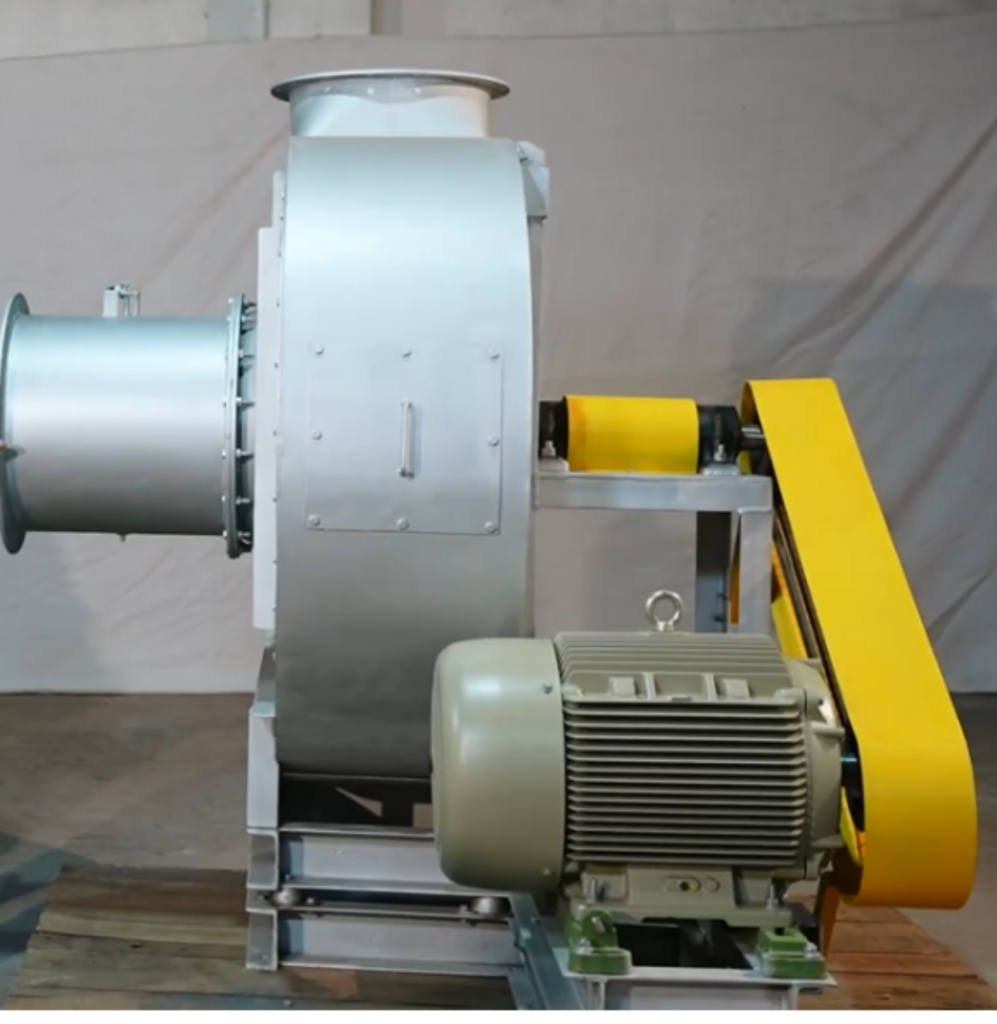
If you’re specifying, replacing, or troubleshooting an industrial fan system, one decision shapes everything downstream, maintenance costs, energy bills, noise levels, and how much control you have over airflow. That decision is belt-drive vs. direct-drive.
Both designs move air. Both have loyal followings among plant engineers. But they solve the problem in fundamentally different ways, and picking the wrong one for your application can mean years of avoidable downtime, wasted energy, or a fan that simply can’t keep up with your process demands.
In this guide, Atmaxfiltration breaks down exactly how each drive type works, where each one wins, and how to match the right system to your facility, whether you’re running a dust collection line, a paint booth, a warehouse ventilation system, or a heavy-duty industrial process exhaust.
What Is a Direct-Drive Industrial Fan?
A direct-drive fan couples the fan wheel (impeller) directly to the motor shaft. There’s no belt, no pulley, no intermediary, the motor spins, and the fan wheel spins with it, at the exact same speed.
How It Works
Motor Shaft → Fan Wheel
Because there are fewer moving parts, the system is mechanically simpler.
Key characteristics:
- Fewer moving parts
- Fan speed is locked to motor speed (unless paired with a VFD)
- Compact footprint
- Sealed or semi-sealed design options available
Typical Applications
- Cleanroom ventilation
- Pharmaceutical HVAC
- Food processing areas
- Small to medium exhaust systems
- Inline duct fans
- Compact ventilation units
- Laboratory exhaust systems
- Low-maintenance continuous operation environments
Direct-drive fans are the go-to choice when simplicity, reliability, and low maintenance matter more than flexibility.
What Is a Belt-Drive Industrial Fan?
A belt-drive fan uses a belt-and-pulley system to transfer power from the motor to the fan wheel. Because the motor and fan wheel spin independently, you can change the pulley ratio to run the fan at a different speed than the motor giving you far more control over airflow (CFM) and static pressure.
How It Works
Motor → Pulley → Belt → Fan Pulley → Fan Wheel
The pulley ratio determines the fan speed, allowing the airflow and static pressure to be adjusted without replacing the motor.
Key characteristics:
- Motor and fan shaft are mechanically separated
- Fan speed is adjustable via pulley/sheave changes
- Requires belt tension checks, alignment, and periodic replacement
- Better suited to high-horsepower, high-static-pressure applications
Typical Applications
- Dust collection systems
- Industrial exhaust ventilation
- Paint booths
- Woodworking facilities
- Welding fume extraction
- Large HVAC air handling units
- Process ventilation systems
- High-temperature exhaust systems
Side-by-Side Comparison
Factor | Direct-Drive | Belt-Drive |
Initial Cost | Lower | Higher |
Maintenance | Minimal (no belts/pulleys) | Regular belt inspection, tensioning, replacement |
Efficiency | Higher — no belt slippage losses | Slightly lower due to transmission losses |
Speed Flexibility | Fixed unless using a VFD | Easily adjustable via pulley changes |
Noise Level | Generally quieter | Can be quieter or louder depending on setup |
Footprint | Compact | Larger, needs belt guard clearance |
Best for High Static Pressure | Limited | Excellent |
Downtime Risk | Lower (fewer failure points) | Belt wear/breakage adds a failure point |
Serviceability | Motor replacement can be more involved | Belts and pulleys are cheap, fast to replace |
When Direct-Drive Is the Right Choice
Direct-drive fans make sense when your facility prioritizes reliability, energy efficiency, and low upkeep:
- Continuous-duty applications where downtime for belt maintenance isn’t acceptable
- Cleanroom or hygienic environments where belt dust and lubricant particles are a contamination risk
- Smaller to mid-size systems where high static pressure isn’t required
- Facilities using VFDs to control speed electronically instead of mechanically
- Operations focused on minimizing energy loss, since there’s no belt slippage to rob efficiency
If your process runs 24/7 and every hour of downtime has a real dollar cost, a direct-drive fan with a quality motor can be the lower-risk long-term investment.
When Belt-Drive Is the Right Choice
Belt-drive systems shine in heavy-duty, high-static-pressure, and variable-demand environments:
- Dust collection and material handling systems that need high static pressure to move air through long ductwork, cyclones, or filter media
- Facilities that anticipate process changes swapping a pulley is far cheaper than replacing an entire fan and motor assembly
- High-horsepower applications where direct-drive motors would need to be oversized and costly
- Situations requiring fine-tuned CFM control to match seasonal or production-driven airflow needs
- Retrofit projects where matching an existing motor to new fan speed requirements is more economical with a pulley change
For demanding industrial filtration and dust collection systems the Atmaxfiltration designs and services daily belt-drive fans often provide the pressure headroom and adjustability that direct-drive units can’t match.
Choosing between belt-drive and direct-drive is important, but it’s only one piece of a properly engineered air handling system. Also consider:
- Static pressure requirements — What does your ductwork, filter bank, or scrubber demand?
- Duty cycle — Continuous operation vs. intermittent use changes the maintenance math.
- Environmental conditions — Dust, heat, corrosive fumes, and humidity all affect component lifespan.
- Filtration integration — Fan sizing must match your dust collector or filtration system’s airflow needs, not just move “enough air.”
- Energy costs over the fan’s lifetime — A cheaper unit today can cost more in electricity over 10 years.
Industry-Specific Recommendations
Metal Fabrication Plant
Recommended: Belt-drive centrifugal fan
Reason: Welding fumes, grinding dust, and future process changes require flexibility and robust construction.
Pharmaceutical Facility
Recommended: Direct-drive plenum or inline fan
Reason: Clean operation, low maintenance, and reduced contamination risk.
Woodworking Shop
Recommended: Belt-drive dust collection fan
Reason: High dust loading and the need for airflow adjustments as equipment changes.
Food Packaging Facility
Recommended: Direct-drive fan
Reason: Sanitation requirements, quieter operation, and reduced maintenance exposure in production areas.
Paint Booth Exhaust
Recommended: Belt-drive fan
Reason: Better motor isolation from solvent-laden exhaust streams and easier
At Atmaxfiltration, we don’t sell one-size-fits-all fans. Our engineering team evaluates your facility’s airflow requirements, static pressure needs, duty cycle, and filtration system to recommend the drive type and the exact fan model that fits your operation.
Whether you need:
- A direct-drive fan for a low-maintenance, energy-efficient application, or
- A belt-drive fan engineered for high static pressure and heavy-duty dust collection
we help you avoid the two most common (and expensive) mistakes: undersizing a fan that can’t keep up, or over-engineering a system that wastes energy and budget.
Final Takeaway
There’s no universal “better” option between belt-drive and direct-drive industrial fans only the option that’s better for your specific application. Direct-drive wins on simplicity and efficiency. Belt-drive wins on power, flexibility, and pressure capability.
Not sure which fits your facility? Contact Atmaxfiltration’s engineering team for a system evaluation, and we’ll help you choose an industrial fan solution built to perform.