
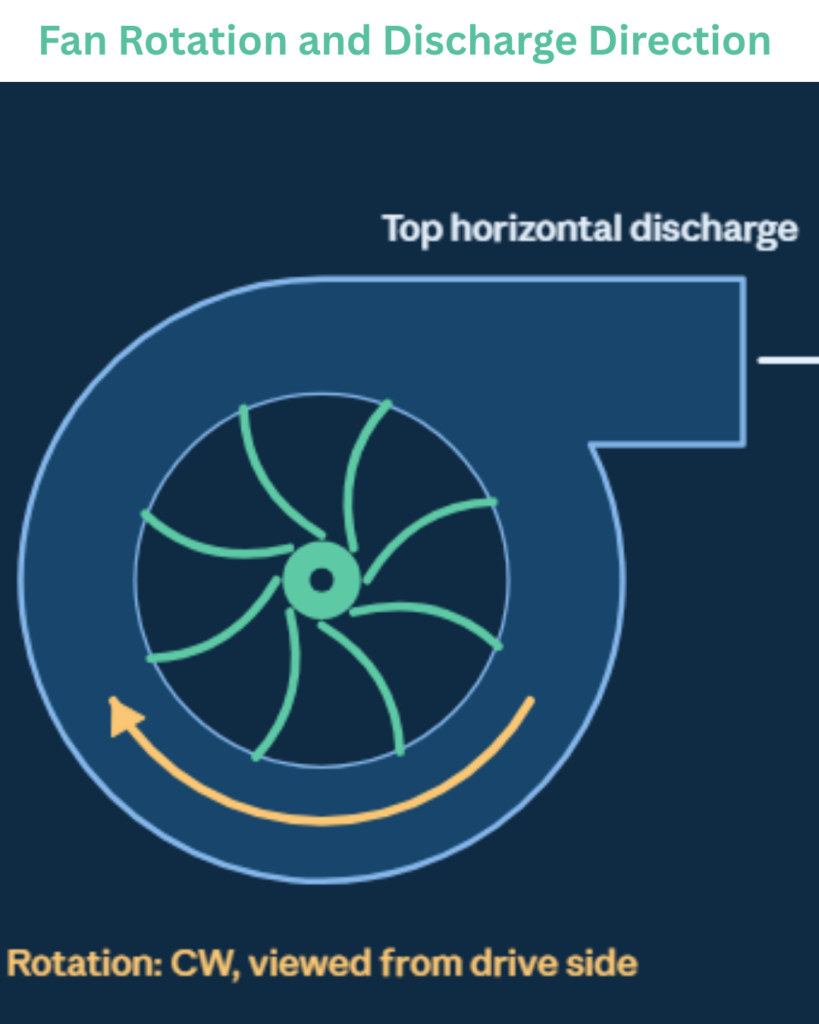
When you specify, commission or troubleshoot industrial fans and blowers, two details are easy to overlook and expensive to get wrong, fan rotation and fan discharge orientation. A mistake in either can leave you with a system that runs, makes noise and moves some air, but never delivers the performance it was designed for.
At Atmax Filtration, we design and support dust collection, fume extraction and air pollution control systems, so we see this issue often. This guide explains what rotation and discharge mean, why they matter, and how to verify them before and after installation.
What Is Centrifugal Fan Rotation (CW and CCW)?
Centrifugal fan rotation describes the direction in which the fan wheel (impeller) turns. It is designated as:
- Clockwise (CW)
- Counterclockwise (CCW)
The standard viewing convention is from the drive side of the fan, meaning the side where the motor or drive (pulley, coupling or shaft extension) is located. Because this convention is easy to misread, always confirm the designation against the manufacturer’s approved drawing instead of relying on assumptions or verbal instructions.
A common source of confusion is looking at the fan from the inlet side, or from the side opposite the drive, reverses your sense of “clockwise.” Rotation errors are frequently just viewing-side errors.
Why Fan Rotation Matters
A centrifugal fan wheel is designed to work in one direction. Its blades, whether backward-inclined, airfoil, radial or forward-curved, are shaped to accelerate air and convert that energy into pressure in a specific rotational direction.
A centrifugal fan running backward can still move air, but it delivers substantially less airflow and pressure than intended.
That is what makes the problem dangerous. Simply feeling air at the outlet does not confirm correct rotation. Someone standing at the discharge may see the fan “working” and assume all is well, while the system is running well below its design duty.
The impact on your process
Reverse rotation, or any rotation mismatch, can lead to:
- Reduced dust and fume capture at hoods, pickup points and enclosures
- Lower duct conveying velocities, which lets dust settle and build up in ductwork and can cause blockages
- Compromised performance of dust collectors, scrubbers and industrial ventilation systems, including poor filtration efficiency and inadequate pollutant removal
- Wasted energy, since the motor runs but the system is not delivering its intended output
- Difficult troubleshooting, because teams may spend days checking filters, ducts and dampers before discovering the fan turns the wrong way
For plants handling combustible dust, toxic fumes or process emissions, inadequate airflow is a compliance and safety concern as well as a productivity problem.
Fan Discharge Directions
Fan discharge refers to the physical direction, or angle, at which air leaves the fan housing into the connected ductwork.
To avoid confusion between manufacturers, engineers and installers, AMCA (Air Movement and Control Association) has standardized the nomenclature for discharge directions. The designation also depends on the rotation direction, so rotation and discharge must always be specified together.
Common discharge positions
Discharge position | Description |
Top Horizontal (TH) | Air leaves horizontally from the top of the housing |
Bottom Horizontal (BH) | Air leaves horizontally from the bottom of the housing |
Upblast (UB) | Air is discharged vertically upward |
Downblast (DB) | Air is discharged vertically downward |
Angular positions, such as top angular up or down and bottom angular up or down, are also defined in the standard.
Why discharge orientation matters
- Duct layout and fit-up: The wrong discharge position may mean unplanned transitions, extra elbows or costly rework on site.
- System pressure loss: Poor duct connections at the outlet, such as sharp turns right at the discharge, add system resistance and cut performance.
- Space and maintenance access: Discharge position affects clearances, stack or duct routing and access to the fan.
- Ordering errors: A fan built for the wrong rotation or discharge is difficult to correct in the field. Housings can sometimes be rotated or reconfigured, but not always, depending on construction and the manufacturer.
A Rotation and Discharge Verification Checklist
1. Approved fan drawings
Confirm the rotation, viewing side and discharge position on the approved drawing. Cross-check these against the purchase specification, the datasheet and the installed duct layout.
2. Rotation arrow on the fan housing
Look for the rotation arrow marked on the fan housing and confirm it matches the drawing. A missing or damaged arrow should be restored to match the approved drawing.
3. Actual wheel rotation
Verify the actual direction of wheel rotation. This must be done by qualified personnel using the manufacturer’s safe startup procedure, with lockout/tagout, guards and access covers in place, and no one near the fan inlet, wheel or drive. Never look into a fan inlet or reach into a housing to check rotation.
4. Measured performance against the specified duty
Rotation alone does not prove performance. Measure and compare:
- Airflow (volume)
- Static pressure
- Fan RPM
Compare the readings with the specified duty point and the fan curve. If the numbers are low despite correct rotation, the problem lies elsewhere in the system.
When Should You Recheck Rotation?
Rotation should not be treated as a one-time commissioning check. Recheck it:
- After motor replacement or rewinding
- After any electrical work, including changes to cabling, terminals, starters, contactors or panels
- After VFD (variable frequency drive) replacement or reprogramming
- After relocating or reinstalling a fan
- After power supply changes that could alter the phase sequence
On a three-phase motor, swapping any two supply leads reverses the direction of rotation, so a routine electrical job can silently turn a healthy fan into an underperforming one.
Troubleshooting Beyond Rotation
If your system has low airflow, rotation is a fast and important first check, but not the only one. Also consider:
- Clogged, blinded or overloaded filter media in the dust collector
- Closed or partly closed dampers
- Belt slippage, loose pulleys or incorrect pulley sizing
- Incorrect fan speed or VFD settings
- Duct leakage, blockages or dust buildup
- System resistance higher than designed, from added bends, hoods or equipment
- Inlet obstruction or poor inlet conditions
- Worn, corroded or dust-coated impellers
A structured check of rotation, RPM, static pressure and airflow against the design duty helps isolate the cause quickly and avoids replacing the wrong component.
How Atmax Filtration Approaches Fan Commissioning
At Atmax Filtration, rotation verification is a formal part of commissioning. Our installation and commissioning technicians and engineers are trained to:
- Verify fan rotation, viewing side and discharge position against approved drawings
- Follow the manufacturer’s safe startup procedures
- Confirm airflow, static pressure and RPM against the specified duty
- Recheck rotation after motor replacement or any electrical work
This discipline helps ensure that dust collectors, fume extraction systems, scrubbers and industrial ventilation systems perform as designed from day one, and stay that way after maintenance.
Frequently Asked Questions
Yes, but it will deliver substantially less airflow and pressure than designed. Feeling air at the outlet is not proof of correct rotation.
By the standard convention, from the drive side. Always confirm against the manufacturer’s drawing.
AMCA has standardized the nomenclature for discharge directions so that manufacturers, engineers and contractors use the same terminology.
Rotation should be checked and corrected only by qualified personnel following the manufacturer’s safe startup and lockout/tagout procedures. On a three-phase motor the fix is typically an electrical change, but it should be done by a qualified electrician or technician.
Yes. Always recheck after motor replacement, rewinding, VFD changes or any electrical work.