
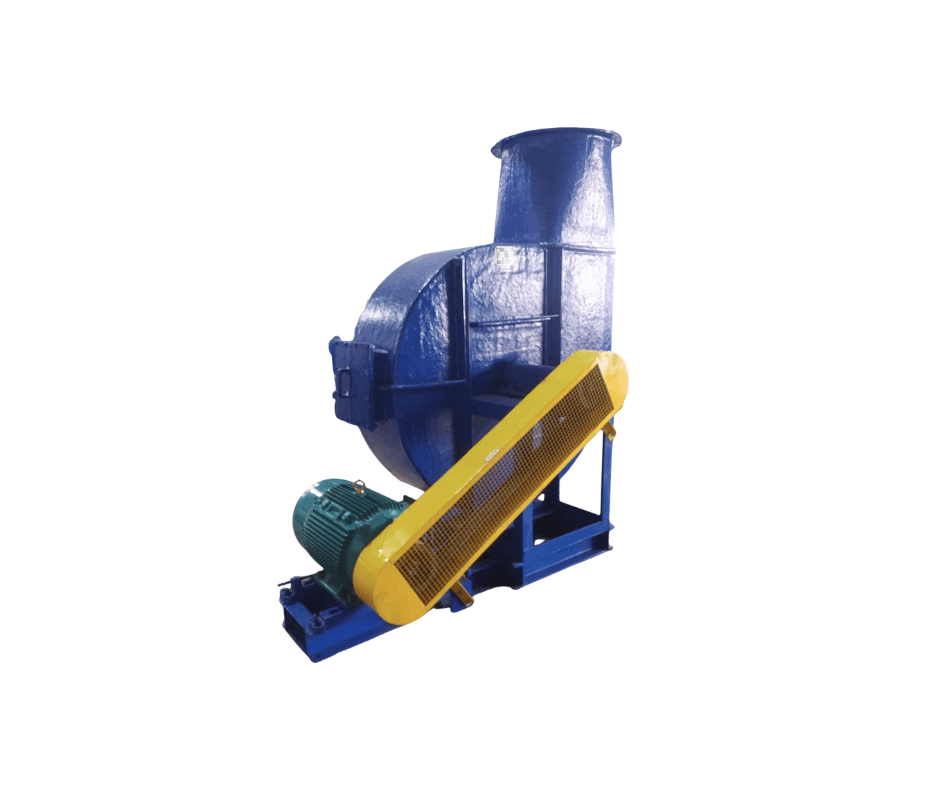
A scrubber can only treat the air it receives. In effluent and wastewater treatment plants, that air is delivered by the fume exhauster fan, and it is usually the first component to fail. Hydrogen sulphide, ammonia, acid mists and saturated humid air attack metal impellers and casings, and when the fan fails, the scrubber stops receiving the airflow it was designed for. Odour escapes, tanks lose negative pressure, and corrosion spreads to everything nearby.
This guide explains how FRP (Fibre Reinforced Plastic) fans work in scrubber systems, how to size and select them, and which design details separate a fan that runs for years from one that needs replacing in months.
Where fume exhauster fans are used in waste treatment
In waste treatment plants, fans extract contaminated air from sources that need to be kept under slight negative pressure and push it through a scrubber before release. Typical applications:
- Equalisation and collection tanks in ETPs and CETPs
- Aeration, biological and anaerobic treatment zones
- Sludge thickening, storage and dewatering areas
- Dissolved air flotation (DAF) units and screening areas
- Chemical dosing and storage rooms
- Sewage pumping stations and STP inlet works
- Industrial waste storage, transfer and solvent handling areas
What the fan has to handle
A scrubber fan does not see clean air. Depending on the source, it may handle:
- Hydrogen sulphide (H₂S) and mercaptans, toxic, odorous and highly corrosive when moisture is present
- Ammonia and amines from nitrogen-rich effluent and sludge
- Acid and alkali mists from process effluent and chemical dosing
- Volatile organic compounds (VOCs) from solvent-bearing waste
- Saturated, humid air with condensate forming inside the casing
- Entrained mist and droplets carried over from the scrubber
H₂S adds a further problem. On damp surfaces, bacteria convert it into sulphuric acid, which attacks steel, concrete and many coatings from the inside. A fan that works for weeks on a test bench can corrode rapidly in this environment.
Why metal fans struggle in scrubber duty
- Mild steel, even painted or epoxy-coated: Coatings chip, blister and get undercut at welds, bolts and edges. Once the coating is breached, corrosion accelerates.
- Stainless steel: Grades such as 304 and 316 can suffer pitting and stress corrosion from chlorides and acidic condensate.
- Imbalance: Deposits and uneven corrosion on a metal impeller shift its balance, which damages bearings and shafts.
Why FRP suits scrubber fans
An FRP fan has a chemically resistant resin-rich inner layer, reinforced with glass for strength. Because the resin is not a coating, there is nothing to peel off.
- Corrosion resistance across a wide range of acids, alkalis and sulphur compounds when the resin is matched to the gas
- Lighter weight, which reduces load on the impeller shaft and supporting structure
- Smooth surfaces that reduce deposit build-up
- Custom fabrication of casing orientation, discharge position and inlet and outlet connections
- Lower lifecycle cost in corrosive service, even when the purchase price is higher than a coated steel fan
A note on limits: FRP is not universal. Hydrofluoric acid attacks glass fibre. Temperatures above the resin’s rating weaken the laminate. Tip speed is limited by laminate strength, so very high-pressure duties may need a different fan design or material. A good supplier will say so.
Choosing the right fan type
Fan type | Best suited for | Considerations |
FRP centrifugal fan (backward-curved or radial blade) | Most scrubber duties, with higher static pressure and corrosive or mist-laden air | The standard choice for packed bed and venturi scrubbers |
FRP fume exhauster fan (centrifugal, belt or direct drive) | Extracting fumes from tanks, process areas and hoods into a scrubber | Check drive arrangement, seal and drain details |
PP (polypropylene) fan | Smaller airflows and lower pressure, with some chemicals including HF | Limited rigidity and temperature range |
FRP axial or inline fan | Low-pressure ventilation without a scrubber in the path | Not suited to high scrubber pressure drops |
Stainless steel fan | Specific solvent and moderate-corrosion duties | Poor choice for chloride-rich or wet acid streams |
Fan position: before or after the scrubber
After the scrubber (induced draft): The fan draws air through the system, so the whole duct network runs under negative pressure. Leaks pull room air in rather than pushing toxic gas out. This is the preferred arrangement for odour and toxic fume control. The fan handles cleaned but saturated air, which suits FRP construction well.
Before the scrubber (forced draft): The fan handles the raw, untreated gas and pressurises the duct. Leaks release contaminants into the plant. This arrangement needs extra caution and is generally avoided for hazardous or odorous streams.
Sizing the fan correctly
Fan performance depends on two numbers working together: airflow and static pressure. Getting either wrong leads to poor capture or wasted power.
Airflow is set by:
- Headspace volume of covered tanks and the required air changes
- Capture velocity at openings, hatches and extraction points
- Gas generation rate from the process
- Reference guidance such as the ACGIH Industrial Ventilation Manual and, for wastewater facilities, NFPA 820
Static pressure is the total resistance the fan must overcome, including:
- Hoods and inlet connections
- Ducting, bends and dampers
- Scrubber packing, spray zone and demister
- Outlet duct and stack
Pressure drop across the scrubber often makes up the largest part of this figure. It changes as packing fouls and the demister loads up, so allow a sensible margin.
Other points to confirm:
- Select the fan to operate in a stable region of its curve, not at the extreme end
- Correct for gas density where temperature, humidity or altitude differ from standard conditions
- Test and rate performance to recognised methods such as AMCA 210 / ISO 5801
- Consider a variable frequency drive (VFD) for varying loads. Under fan laws, power varies roughly with the cube of speed, so a 20% speed reduction cuts power by around half
Construction details that matter
Specifying “FRP fan” is not enough. Check these details:
- Resin and corrosion barrier: Vinyl ester is common for scrubber duty, with a resin-rich inner layer and a synthetic surface veil. Specify the resin against the actual gas composition and temperature.
- Shaft and seal: The shaft passing through the casing is a weak point. It needs a suitable seal, gland or purge arrangement and a corrosion-resistant sleeve or coating.
- Motor outside the airstream: Keep motor and bearings on a pedestal or support, away from corrosive gas.
- Drain connection: A drain at the lowest point of the casing prevents condensate from pooling and unbalancing the impeller.
- Balanced impeller: Dynamic balancing, with vibration checked at commissioning.
- Casing and supports: Ducting should be supported independently so that its weight never loads the fan casing, and flexible connectors should isolate vibration.
- UV protection: Outdoor fans need a UV-stabilised outer layer to prevent surface degradation.
Hazardous areas and static protection
Some waste treatment locations can contain flammable gases or vapours, such as biogas near digesters, or solvent vapours from industrial waste. In these areas:
- Static build-up on plastic surfaces must be controlled, using conductive or static-dissipative FRP with proper earthing
- Impeller and casing clearances should follow spark-resistant construction guidance such as AMCA 99
- Motors and electrical equipment must be rated for the area classification
The area classification should be defined by the plant’s safety team before the fan is specified.
Matching the fan to the scrubber
The fan and scrubber should be designed together, not bought separately. Common scrubber duties in waste treatment:
- H₂S and sulphide odours: Caustic soda and sodium hypochlorite solution, often in a multi-stage arrangement
- Ammonia and amines: Dilute acid solution, commonly sulphuric acid
- Mixed odour and VOC streams: Staged scrubbing, sometimes followed by activated carbon
Whichever the chemistry, the scrubber needs a demister to stop liquid carrying over into the fan, as well as pH and level control to hold performance steady. Carry-over is a leading cause of fan imbalance and casing wear.
Common mistakes to avoid
- Selecting the fan on airflow alone and ignoring scrubber pressure drop
- Choosing coated steel to save on purchase cost, then replacing it repeatedly
- No drain on the fan casing, so condensate collects and wets bearings
- Resin chosen without checking the actual gas chemistry and temperature
- Supporting ducting or scrubber outlets from the fan casing
- Placing the fan before the scrubber on toxic or odorous streams
- No access for inspection of impeller, seal and demister
Maintenance checklist
- Check vibration and bearing temperature routinely
- Inspect the impeller for deposits, cracks and resin surface damage
- Clear the casing drain and check the seal
- Inspect flexible connectors and duct supports
- Check belts, tension and alignment (belt-driven fans)
- Monitor scrubber pressure drop. A rising trend means the fan is working harder to compensate.
Need an FRP fan or fume exhauster for your scrubber?
Atmaxfiltration supplies FRP fans and fume exhauster fans matched to scrubber systems in effluent treatment, wastewater and industrial waste handling.
To get an accurate selection quickly, share:
- Source of fumes (tank, process area, sludge area, chemical room)
- Gases or odours involved, such as H₂S, NH₃, acid mist or VOCs
- Required airflow and estimated static pressure (or scrubber details)
- Gas temperature and humidity
- Indoor or outdoor installation, and any hazardous-area classification
- Current fan problems (corrosion, vibration, low airflow)