
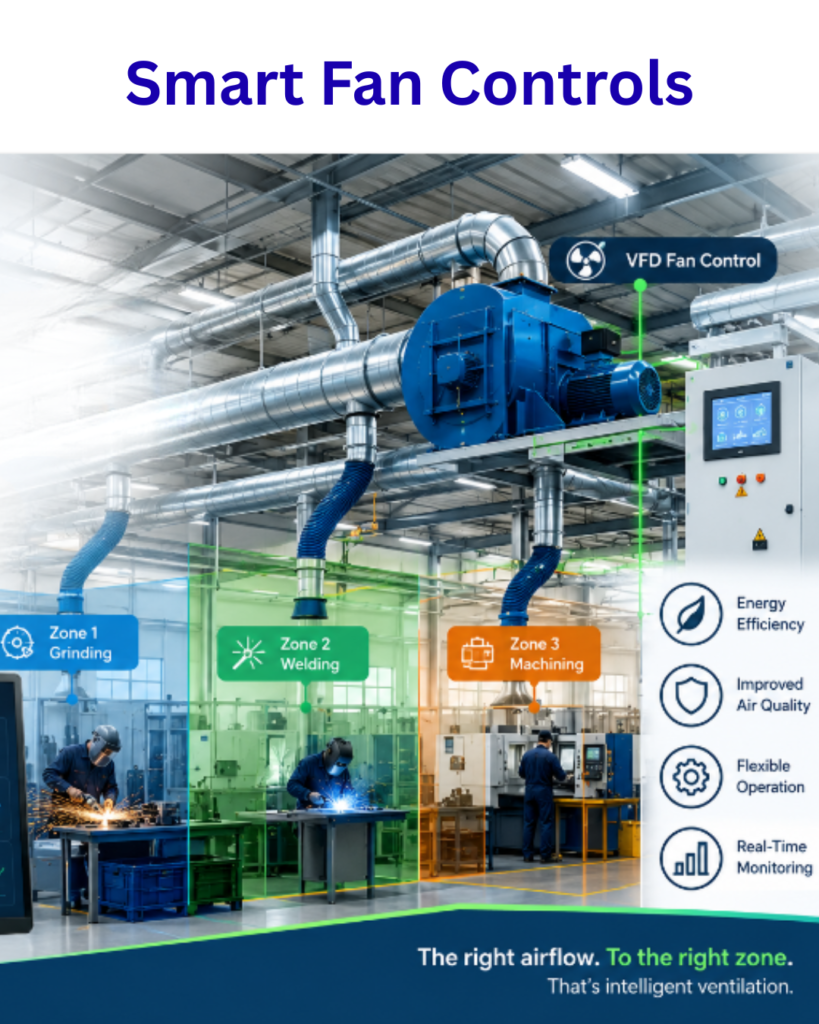
A central exhaust fan is rarely asked to do the same job throughout a production shift.
At 9 a.m., ten machines may be running. By noon, three may be shut down. The welding area may be busy while the grinding section is idle. A second shift may operate only half the production floor.
Yet in many plants, the ventilation fan continues running at the same speed.
That is where smart fan controls become useful.
The objective is not simply to automate an industrial fan. It is to make the ventilation system respond to what is actually happening on the shop floor.
For facilities with multiple extraction points, dust-generating equipment, welding stations, process exhausts, or variable production schedules, zone-based airflow control can turn a fixed ventilation system into a demand-responsive one.
What Is Zone-Based Airflow Control in Industrial Ventilation?
Smart fan controls combine process signals, sensors, dampers, VFDs, and a control system to adjust ventilation according to operating conditions.
A typical sequence may look like this:
Machine starts → Extraction zone opens → Fan responds → Required airflow is maintained
When the machine stops:
Machine stops → Branch is isolated → Fan demand decreases
The control system can use signals from:
- Production equipment
- Airflow sensors
- Static pressure sensors
- Differential pressure sensors
- Temperature sensors
- Particulate sensors
- VOC monitoring systems
- VFDs
- Motorized dampers
- PLCs
The exact combination depends on the process and the level of control required.
How VFD Fan Control Improves Industrial Airflow Management
A Variable Frequency Drive (VFD) allows an industrial fan motor to operate at different speeds rather than remaining at one fixed speed.
This becomes particularly useful when airflow demand changes.
During peak production, the fan can operate at the required design condition.
When extraction demand decreases, fan speed can be reduced.
When additional zones become active, the system can increase fan speed again.
But there is an important engineering consideration:
A VFD should not simply be used to slow a fan down whenever fewer machines are operating.
Minimum airflow requirements, fan curves, static pressure, motor operating limits, duct transport conditions, and contaminant capture requirements must all be considered.
For dust and fume extraction systems, maintaining effective capture remains the priority.
The Role of Motorized Dampers in Zone-Based Ventilation
VFDs control fan speed, while motorized dampers can control individual ventilation branches.
Consider a central dust collector connected to twelve machines.
If only four machines are operating, the corresponding four extraction branches can remain active while the unused branches are isolated.
The central fan can then respond to the reduced system demand.
This approach can provide much better control than allowing every branch to remain permanently open.
It can also help the system respond quickly when production conditions change.
Static Pressure Control for Multi-Zone Industrial Fan Systems
Static pressure becomes increasingly important when one fan serves multiple zones.
When branches open and close, the resistance of the duct system changes.
If the fan continues operating at the same speed, the resulting airflow conditions can change throughout the system.
A pressure sensor can provide feedback to the control system.
For example:
More zones open → System demand changes → Static pressure changes → Fan speed adjusts
And:
Zones close → System demand decreases → Fan speed reduces
The sensor location and pressure setpoint need to be established from the actual duct and fan design.
This is one reason industrial fan automation should be engineered together with the ventilation system, rather than treated as a separate electrical upgrade.
Smart Controls for Industrial Dust Collection Systems
Dust collection is one of the strongest applications for zone-based fan control.
A centralized dust collector may serve:
- Grinding machines
- CNC equipment
- Cutting machines
- Sanding stations
- Welding stations
- Mixing equipment
- Material handling points
These machines may not operate simultaneously.
A smart control system can use machine-status signals to determine which extraction points are active.
When a machine starts, its extraction branch can open.
When the machine stops, the branch can be isolated.
The central fan can then adjust its operating condition based on the active zones.
However, dust collection requires more than simply reducing airflow whenever branches close.
The system must still maintain the airflow and duct conditions required to capture and transport the generated dust effectively.
Industrial Fume Extraction and Zone-Based Fan Automation
Fume extraction systems can also benefit from demand-based control.
Welding, thermal cutting, brazing, soldering, and similar operations can generate fumes intermittently.
If extraction points are operated according to actual process activity, ventilation can be better matched to production.
For example:
Welding station active → Local extraction operates
Welding station inactive → Extraction reduces or isolates
For hazardous fumes or processes with minimum ventilation requirements, however, the control sequence must be designed around the exposure-control requirement.
Energy optimization should never compromise contaminant control.
Using Air Quality Sensors for Demand-Controlled Ventilation
Depending on the process, sensors may monitor:
- Particulate concentration
- VOC levels
- Temperature
- Humidity
- CO₂
- Specific gases
The control system can use these measurements to identify changing conditions and adjust ventilation where appropriate.
This moves the system from simple scheduled operation toward feedback-based industrial ventilation control.
Where Zone-Based Industrial Fan Controls Work Best
Zone-based ventilation is particularly useful in facilities where airflow requirements change throughout the day.
Typical applications include:
Industrial Dust Collection Systems
Grinding, cutting, sanding, machining, and material-handling operations often have variable extraction requirements.
Welding Fume Extraction Systems
Individual welding stations may operate independently, making centralized demand-based extraction practical.
Manufacturing Plants
Different production lines may start and stop at different times.
Automotive Manufacturing Facilities
Welding, grinding, painting, and other processes can have substantially different ventilation requirements.
Metalworking and Foundry Operations
Process exhaust requirements can change with production schedules and operating conditions.
Food Processing Facilities
Heat, moisture, dust, and process exhaust requirements can vary between production areas.
What Should Be Monitored in an Automated Industrial Ventilation System?
A smart ventilation system should provide useful information to the operator rather than simply adding another control screen.
Depending on the application, useful parameters include:
- Fan operating status
- Fan speed
- Static pressure
- Airflow
- Damper position
- Filter differential pressure
- Motor status
- VFD alarms
- Zone operating status
- High- and low-pressure alarms
Historical trends can also reveal developing problems.
For example, if a fan progressively requires higher speed to maintain the same operating condition, there may be an underlying issue with the system.
Similarly, a rapid increase in filter differential pressure may indicate a developing filtration or process problem.
Can Smart Fan Controls Reduce Industrial Ventilation Energy Consumption?
Yes but only when the ventilation system is suitable for variable operation.
The largest opportunity generally occurs when a fan operates for long periods at high capacity while actual airflow demand varies significantly.
Reducing fan speed during lower-demand conditions can reduce power consumption.
But energy savings should be evaluated against:
- Required capture airflow
- Fan operating point
- Static pressure
- Motor efficiency
- VFD efficiency
- Operating hours
- Filter pressure drop
- Duct transport requirements
- Minimum ventilation requirements
A VFD by itself is not an energy-management strategy.
The control logic determines whether the VFD is actually being used effectively.
How to Design a Zone-Based Industrial Fan Control System
The controls should follow the ventilation design.
Before selecting PLCs, VFDs, or sensors, engineers should establish:
- What contaminant is being controlled?
- Where is it generated?
- What capture airflow is required?
- Which equipment operates simultaneously?
- How does the duct system behave when zones open and close?
- What static pressure must be maintained?
- What is the acceptable fan operating range?
- Which conditions require continuous ventilation?
- What should happen during a sensor or VFD failure?
- What alarms and interlocks are required?
Only after these questions are answered should the automation architecture be finalized.
Industrial Fan Automation and Airflow Control
Atmax Filtration works with industrial ventilation and dust collection systems where airflow requirements can change with production conditions.
Rather than treating the fan, dust collector, ductwork, dampers, and controls as separate components, we look at how they operate as one system.
Our support can include:
- Industrial fan and blower selection
- Dust collector integration
- VFD-based fan control
- Motorized damper integration
- Static pressure monitoring
- Zone-based airflow control
- PLC and control-panel integration
- Ventilation troubleshooting
- System balancing
- Startup and commissioning
The objective is to deliver the required airflow to the areas that need it, while keeping the overall system stable, safe, and efficient.
The Future of Industrial Ventilation Is Demand-Based Airflow
The value of smart fan controls is the ability to make ventilation respond to the actual operating condition of the facility.
When a production zone starts, airflow responds.
When extraction demand falls, the system adjusts.
When filter resistance changes, the operator can see it.
And when a process requires continuous ventilation, the control system maintains it.
That is the real purpose of zone-based airflow automation is to make it behave more intelligently than a fan that simply runs at one speed for an entire shift