
EC Fan Arrays: Benefits, Applications, and How to Choose One
An EC fan array replaces one large fan with a grid of smaller electronically commutated (EC) fans that work together. The result is lower energy use, built-in redundancy, and finer airflow control for HVAC and industrial ventilation systems.
For facilities under pressure to cut power consumption without giving up uptime, that combination is why fan arrays are showing up in more air handling unit (AHU) designs. This guide explains how EC fan arrays work, where they fit, how they compare with traditional fans, and how to choose one.
What is an EC Fan Array?
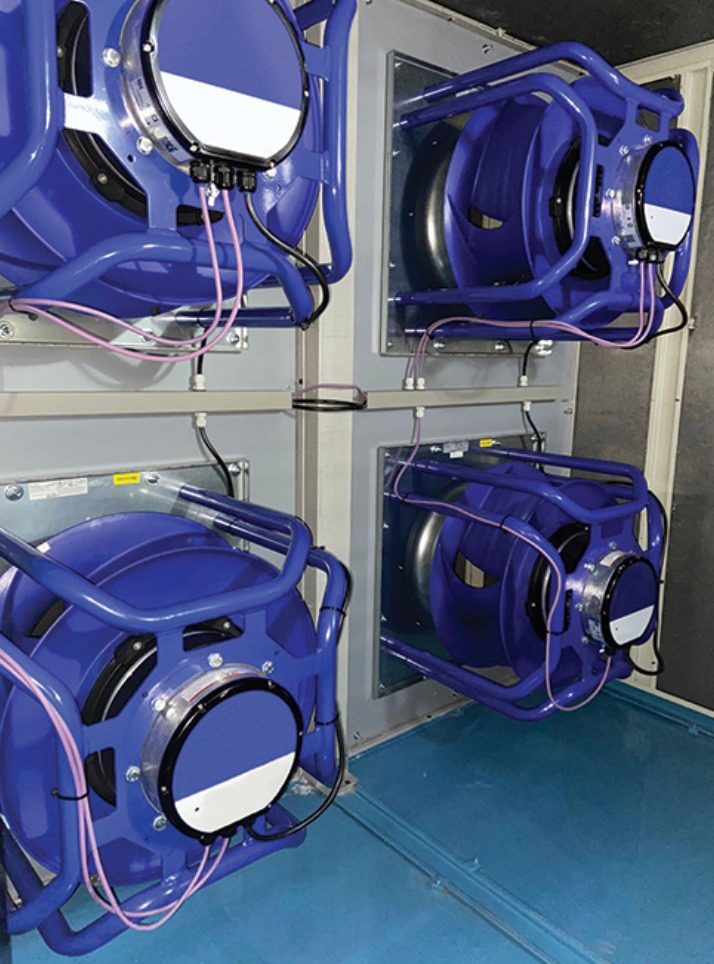
An EC fan array, is a group of multiple smaller fans installed side by side in a single plane, typically inside an air handling unit or plenum. Each fan is driven by its own electronically commutated motor, which is a brushless DC motor with built-in control electronics.
Because each fan runs independently, the array can adjust its output to match demand and keep operating even if one unit fails. A traditional design relies on one large fan, so a single failure can take the whole system down.
How EC Fan Arrays Work
EC motors combine a brushless DC motor with onboard electronics that manage speed and efficiency. A control signal, usually 0–10 V or a network protocol such as Modbus or BACnet, tells the fans how fast to run. All the fans in the array typically receive the same signal, so they ramp up and down together to deliver consistent airflow.
This matters because of the fan affinity laws: fan power rises roughly with the cube of speed. Slowing a fan by 20% cuts its power draw to about half (0.8³ ≈ 0.51). Since most systems run at part load for much of the year, even modest speed reductions add up. For a deeper look at the math, see our guide to the fan affinity laws.
Key Features
- High efficiency: EC motors stay efficient across a wide speed range, including at part load.
- Built-in redundancy: If one fan fails, the others ramp up to compensate and airflow continues.
- Precise speed control: Output follows demand without a separate variable frequency drive (VFD).
- Controls integration: EC fans connect easily to a BMS or PLC for monitoring and automation.
Benefits of EC Fan Arrays
1. Lower Energy and Operating Costs
EC fan arrays can reduce fan energy use by up to 50% compared with some traditional fan systems. Actual savings depend on your existing equipment, load profile, and operating hours, so treat any headline figure as a starting point and confirm it with a system-specific estimate. For more ways to trim utility costs, see energy optimization opportunities in industrial utility systems.
2. Redundancy and Uptime
With N+1 redundancy, the array is sized with at least one more fan than the load strictly requires. If a fan fails, the others absorb its share and the system keeps running while the faulty unit is replaced. That is a major advantage in data centers, cleanrooms, and process areas where downtime is costly.
3. Easier Maintenance
Instead of replacing or rebuilding one large fan, maintenance teams can swap an individual fan unit, often while the system is running. EC motors also have no belts to tension or replace, which removes a common maintenance task.
4. Better Airflow Distribution
Spreading airflow across a grid of fans gives more even air velocity across coils and filters, which can improve heat transfer and filter performance. Arrays can also be shorter in the airflow direction than a single large fan with its inlet cone, which sometimes helps in space-constrained AHUs.
Applications of EC Fan Arrays
- Data centers: Precision cooling with variable loads and a need for redundancy.
- Cleanrooms and pharmaceutical facilities: Consistent airflow and contamination control. See our overview of industrial fans for pharmaceutical manufacturing and cleanrooms.
- Commercial HVAC: Air handling units in offices, hospitals, labs, and other large buildings.
- Manufacturing and process industries: Ventilation and cooling where reliability and energy cost both matter. Explore our full range of industrial fans.
Retrofitting an Existing System
Many existing AHUs can be converted from a single belt-driven fan to an EC fan array. A typical retrofit follows these steps:
- Assess the current unit: Record the existing fan type, motor size, and cabinet dimensions.
- Measure actual operating conditions: Confirm airflow (CFM) and static pressure at real operating points, not just the original design values.
- Size the array: Select fan quantity and size to meet the duty point with N+1 redundancy.
- Check structure and electrical capacity: Confirm the mounting frame, wiring, and power supply.
- Integrate controls: Connect to your BMS or PLC and set control sequences.
- Commission and verify: Test airflow, balance the system, and confirm energy performance.
If you need help sizing, our article on how to size a centrifugal fan for your facility covers the fundamentals.
How to Choose the Right EC Fan Array
- Define your airflow requirement. Calculate the design CFM, and also the minimum and typical operating points.
- Account for static pressure and system resistance. Include filters, coils, dampers, and ductwork, since these determine the right fan size and configuration.
- Decide on redundancy. Choose N+1 or higher based on how costly downtime would be.
- Check controls compatibility. Confirm support for your BMS or PLC protocol. See our automation and control panels for related capabilities.
- Evaluate noise and vibration. Plan for isolation and acoustic treatment where needed. Our guide to vibration isolation in HVAC systems can help.
- Review lifecycle cost, not just price. Compare energy savings, maintenance, and downtime risk against the upfront investment.
Limitations to Consider
EC fan arrays are not the right answer for every application:
- Upfront cost is often higher than for a conventional fan.
- Onboard electronics can be sensitive to high temperatures and poor power quality, so check the operating environment.
- Very high-pressure or harsh-duty applications (corrosive, dusty, or high-temperature air streams) may be better served by a robust centrifugal fan or blower. [Link to relevant product page.]
- Replacement parts are tied to the manufacturer, so confirm availability and lead times.
Future Trends
EC fan technology is moving toward more connected operation: fan-level diagnostics, demand-based control tied to building or process data, and predictive maintenance alerts. Learn how this fits into broader facility strategy in our post on zone-based airflow automation for modern industrial facilities.
Conclusion
EC fan arrays offer a practical way to improve efficiency, reliability, and control in modern airflow systems. They are especially valuable where part-load operation is common and downtime is costly, though upfront cost and environmental limits should be weighed carefully.
Not sure whether an EC fan array or another fan type is right for your facility? Request a quote or contact our engineering team for help with sizing and selection.
Frequently Asked Questions
EC fans use brushless DC motors with built-in electronics for speed control. AC fans use induction motors and typically need a separate VFD for variable speed.
Savings depend on your baseline equipment and load profile. Comparisons against belt-driven, damper-controlled systems show the largest gains
Often yes, depending on cabinet size, airflow, and static pressure. A system review is the best way to confirm.
The remaining fans increase speed to compensate, so airflow continues while the failed unit is replaced.
Yes. Their precise control, even airflow, and redundancy suit applications where consistency and uptime are critical.