
Control Panels for Fans and Dust Collectors: VFDs, PLCs, and Interlocks Explained
A dust collector is only as reliable as the panel that runs it. The filters, hopper, and fan get most of the attention, but the control panel decides how much energy the system burns, how long the filter media lasts, and whether a fault becomes a minor alarm or a shutdown.
This guide explains how VFDs, PLCs, and interlocks work together in a modern dust collector control panel, and what to look for when specifying one for your plant.
What Does a Dust Collector Control Panel Do?
A control panel is the brain of your air filtration system. It starts and stops the main fan, runs the filter cleaning cycle, manages auxiliary equipment such as rotary valves, screw conveyors, and dampers, and monitors conditions like differential pressure, motor load, and hopper level. It also protects people and equipment through safety interlocks.
A basic system may use a simple starter with a timer board. A modern system uses a VFD (variable frequency drive), a PLC (programmable logic controller), and a hardwired interlock scheme working together.
VFDs
Most dust collector fans are sized for worst-case airflow, such as every hood open and filters at their dirtiest. In practice, plants rarely run at that point. Without a VFD, the fan runs at full speed regardless, and a damper wastes the excess by throttling.
Why VFDs matter for fans
- Energy savings. Under the fan affinity laws, power consumption falls roughly with the cube of speed. Cutting fan speed by 20% can reduce power draw by nearly half.
- Soft starting. Large fan motors draw a heavy inrush current on direct-on-line starts. A VFD ramps the motor up gently, easing stress on the motor, belts, bearings, and your electrical supply.
- Constant airflow as filters load. As filters collect dust, system resistance rises and airflow drops. A VFD can increase speed automatically to hold your target airflow or static pressure.
- Lower noise and wear. Running slower when full capacity isn’t needed reduces noise, vibration, and mechanical wear.
- Process flexibility. If production lines shut down or hood gates close, the fan can slow down instead of running flat out.
VFD selection tips
Size the drive for the motor’s full-load amps, not just kW. Check for harmonic mitigation (line reactors or DC chokes) where power quality matters. Specify appropriate enclosure ratings and cooling for dusty or hot environments. Avoid running the fan at speeds that excite its resonant frequencies, and use the VFD’s skip-frequency function if needed.
PLCs: Automating Cleaning, Monitoring, and Sequencing
A PLC dust collector control system replaces fixed-timer logic with programmable, data-driven control. It is especially valuable for pulse-jet collectors.
Key PLC functions
- On-demand pulse cleaning. Timed cleaning fires compressed air pulses at fixed intervals whether the filters need it or not. That wastes compressed air and shortens bag or cartridge life. With a differential pressure (DP) transmitter, the PLC pulses only when pressure drop crosses a high setpoint and stops at a low setpoint. This extends filter life and reduces compressed air consumption.
- Sequenced startup and shutdown. The PLC makes sure equipment starts in the correct order (rotary valve and conveyor before the fan, for example) and runs post-cleaning cycles on shutdown, which clears the filters before the next start.
- Alarms and diagnostics. Typical alarms include high or low differential pressure, motor overload, solenoid valve failure, hopper high level, and low compressed air pressure. Clear alarm messages cut troubleshooting time.
- Data logging and remote access. Trending DP, fan speed, and runtime hours supports predictive maintenance and compliance reporting. With an HMI or remote connectivity, operators and maintenance teams can see system status at a glance.
- Integration. A PLC can talk to your plant SCADA, building management system, or production line controls over common industrial protocols.
Interlocks: The Safety and Protection Layer
Interlocks are conditions that must be true before equipment runs, or that stop equipment when something goes wrong. Many should be hardwired or safety-rated rather than relying on software alone.
Common dust collector interlocks
- Fan and damper interlock. Prevents the fan from starting against a closed damper, and prevents damage from airflow reversal.
- Rotary valve and discharge interlock. Stop the fan or alarms if the rotary valve or screw conveyor fails, so the hopper doesn’t overfill.
- Hopper level interlock. A high-level switch triggers an alarm or shutdown before dust backs up into the filters.
- Compressed air pressure interlock. Inhibits or alarms the cleaning cycle when air pressure is too low to clean effectively.
- Motor protection. Overload, phase failure, and over-temperature trips protect the fan motor.
- Access door and maintenance interlocks. Prevent operation while doors are open and support lockout/tagout procedures.
- Fire and explosion protection interlocks. Spark detection, suppression, explosion venting, and isolation devices should tie into the panel so the fan shuts down and isolation valves close when a hazard is detected.
Combustible dust considerations
If you handle combustible dusts such as wood, grain, metal, sugar, or certain plastics and chemicals, your control and safety design must follow applicable standards such as NFPA 652 and NFPA 660, or ATEX/IECEx where relevant. A dust hazard analysis (DHA) should drive which interlocks, detectors, and protective devices are required. Panels may also need to be installed outside the hazardous area or designed for the classified zone.
How VFDs, PLCs, and Interlocks Work Together
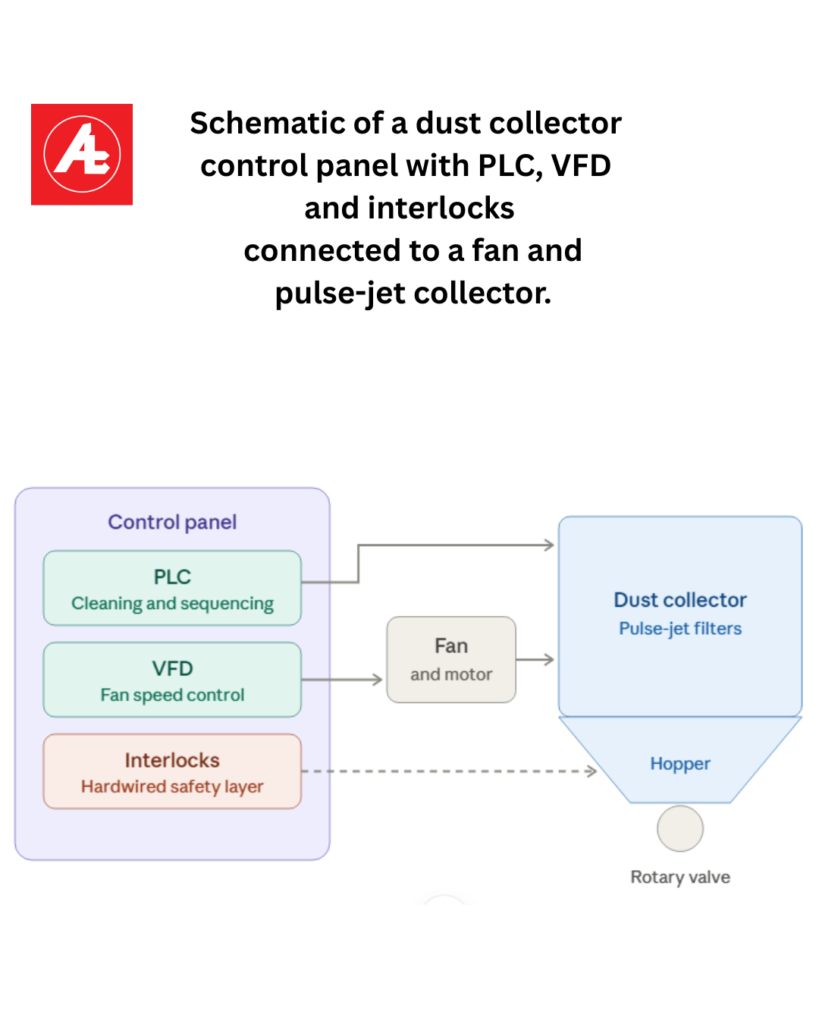
A well-designed panel layers these elements:
- PLC handles sequencing, cleaning logic, and monitoring.
- VFD modulates fan speed based on PLC commands or a pressure/airflow setpoint.
- Hardwired interlocks and safety relays act independently of software to stop the system in unsafe conditions.
- HMI gives operators a clear view of status, alarms, and settings.
This layered approach gives you efficiency without sacrificing safety.
Control Panel Design Checklist
When specifying a fan and dust collector control panel, confirm the following:
- Enclosure rating: NEMA 12, 4, or 4X (or IP equivalents) suited to dust, moisture, or washdown conditions
- Build standard: built by a qualified panel shop to UL 508A or the IEC standards that apply in your region
- Component quality: recognised brands for VFDs, PLCs, contactors, and relays, with locally available spares
- Cooling and ventilation: especially important for VFDs in hot or dusty rooms
- Clear labelling and documentation: electrical drawings, I/O lists, and a wiring schedule
- Scalability: spare I/O and communications for future expansion
- Lockout points and emergency stop: accessible and clearly marked
- FAT and commissioning support: factory testing before shipping and help at start-up
Common Problems a Good Panel Prevents
- Filters blinding early because of timer-only cleaning
- Excessive compressed air use from cleaning too often
- Fan motor failures from repeated hard starts
- Hopper overflows and filter damage
- Unplanned downtime from poorly diagnosed faults
- Safety incidents from missing or bypassed interlocks.
Conclusion
The right control panel turns a dust collector from a simple fan-and-filter box into an efficient, protected, and monitored system. VFDs save energy and protect motors, PLCs optimize cleaning and diagnostics, and interlocks keep people and equipment safe.
If you’re planning a new installation or upgrading an existing one, Atmax Filtration can help you specify a control panel matched to your dust, airflow, and compliance needs. Contact our team for a consultation or a quote.
Frequently Asked Questions
Not all, but any system with variable demand, high energy use, or a need for constant airflow benefits from one. Larger fans usually pay back quickly.
Yes. Retrofitting a DP-based cleaning controller, a VFD, and updated interlocks is a common upgrade that improves efficiency and filter life without replacing the collector.
A timer board fires pulses on a fixed schedule. A PLC can use real-time data such as differential pressure, run sequences, log trends, and handle alarms and communications
It depends on your dust type, process, and local regulations. A hazard analysis and a qualified controls engineer should guide the final scheme.