
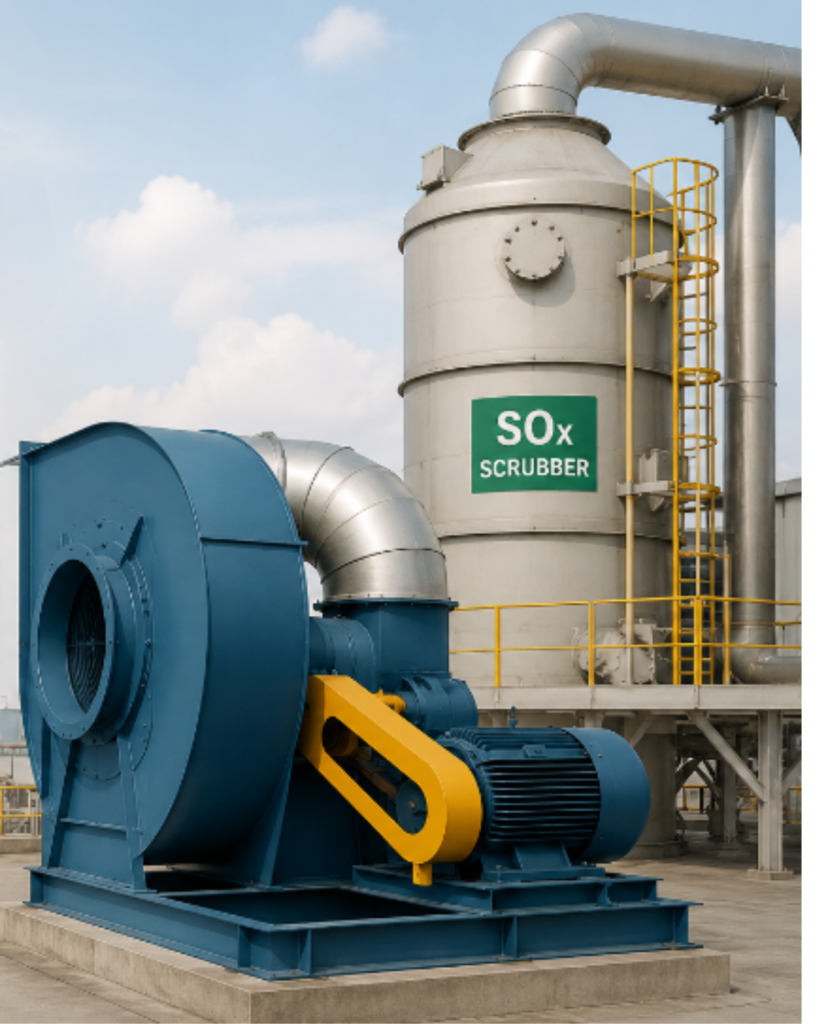
SOx scrubber systems remove sulphur oxides from industrial and marine exhaust gases. Since the scrubber adds pressure drop to the exhaust line, a properly selected centrifugal fan is required to maintain the required airflow and control system backpressure.
Fan selection depends on factors such as airflow, static pressure, gas temperature, moisture, corrosion conditions, and scrubber pressure drop.
In this blog, we will look at the key factors to consider when selecting centrifugal fans for SOx scrubber systems.
What Is an SOx Scrubber System?
SOx scrubbers, also known as Exhaust Gas Cleaning Systems (EGCS), reduce sulphur oxide emissions from exhaust gases.
In marine applications, scrubbers provide an alternative compliance method under MARPOL Annex VI. The IMO sulphur limit for fuel oil used outside designated emission control areas was reduced to 0.50% m/m from 1 January 2020, while approved exhaust gas cleaning systems can be used as an alternative means of meeting the applicable requirements.
A typical scrubber system receives exhaust gas from an engine, boiler or other combustion source and passes it through a scrubbing section. Water, sometimes with an alkaline additive depending on the system configuration, comes into contact with the exhaust gas and removes sulphur compounds before the treated gas is discharged.
However, this process introduces additional resistance to the exhaust path.
The ventilation system must handle the pressure loss and, in many applications, is driven by a dedicated ID (Induced Draft) fan.
Why Is a Fan Required in an SOx Scrubber System?
The exhaust gas already has to travel through ducts, dampers, silencers, and other components. Adding a scrubber introduces another significant pressure drop.
If the existing exhaust fan or combustion-air system cannot overcome this additional resistance, the result can be:
- Increased exhaust backpressure
- Reduced combustion performance
- Unstable boiler operation
- Reduced engine efficiency
- Higher fan power consumption
- Difficulty maintaining the required exhaust flow
A properly selected centrifugal fan helps compensate for the pressure loss created by the scrubber while maintaining stable exhaust gas movement.
In some configurations, an ID fan is installed between the combustion equipment and the scrubber, while the existing combustion-air system may require an FD fan upgrade to maintain the required air supply. The exact arrangement depends on the process and system design.
ID Fan vs FD Fan in Scrubber Applications
The two fan arrangements serve different purposes.
ID Fan – Induced Draft
An ID fan pulls exhaust gas through the system and pushes it toward the stack.
In an SOx scrubber installation, it may be positioned downstream of the combustion equipment and upstream of the scrubber, or elsewhere as determined by the system designer.
Its primary responsibility is to maintain the required gas flow in the exhaust system.
FD Fan – Forced Draft
An FD fan supplies combustion air to the boiler or combustion equipment.
When a scrubber installation changes the overall system pressure conditions, the combustion-air fan may also need to be reviewed or resized.
The objective is not simply to increase fan capacity. The complete system needs to be evaluated so that combustion air, exhaust flow, and system pressure remain balanced.
What Makes a Centrifugal Fan Suitable for SOx Scrubber Duty?
SOx scrubber applications can present a more demanding operating environment than a conventional air-handling application.
The fan selection should therefore consider more than just CFM.
1. Airflow
The fan must deliver the required exhaust gas volume under actual operating conditions.
Selecting a fan based only on free-air capacity can result in insufficient airflow once the scrubber, ductwork, and other system components are included.
2. Static Pressure
This is one of the most important selection parameters.
The fan needs enough pressure capability to overcome the combined resistance of:
- Exhaust ductwork
- Dampers
- Silencers
- Scrubber
- Mist eliminators
- Stack
- Other downstream equipment
The scrubber’s pressure drop should therefore be included in the fan duty calculation.
3. Gas Temperature
Exhaust gas temperature can vary considerably depending on the equipment and location of the fan.
Temperature affects gas density and therefore affects the actual volume and pressure requirements of the fan.
The fan should be selected for the expected operating temperature range rather than assuming standard ambient-air conditions.
4. Corrosion Resistance
Scrubber systems involve water and chemically active compounds. Depending on the system design and fan location, moisture and corrosive contaminants can become important considerations.
Material selection, protective coatings, drainage arrangements and construction details should therefore be evaluated based on the actual gas composition and operating conditions.
5. Moisture and Condensation
A fan handling scrubber exhaust may encounter high humidity and, depending on operating conditions, condensation.
This can lead to corrosion, deposits, and imbalance if the fan is not designed appropriately.
Drainage and internal construction should be considered during equipment selection.
6. Fan Efficiency
A scrubber system can operate continuously for long periods, making fan power consumption an important operating cost.
Select a fan close to its efficient operating region rather than simply choosing the largest available model.
Correct sizing can reduce unnecessary energy consumption while maintaining the required exhaust performance.
Fan Location Matters
Fan location can significantly affect equipment life and maintenance. One important question is whether the fan should handle the exhaust gas before or after the scrubber.
If the fan is installed on the dirty-gas side, it may be exposed to contaminants, moisture, and corrosive components present in the untreated exhaust.
A fan installed on the clean-gas side may experience different operating conditions but must still be evaluated for temperature, moisture and residual contaminants.
There is no universal fan location for every scrubber installation. The correct arrangement depends on the scrubber design, gas temperature, pressure drop, moisture conditions, and overall exhaust system configuration.
This is why fan selection should be done together with the scrubber and exhaust-system design.
What Should Be Checked Before Selecting the Fan?
For an SOx scrubber application, Atmax recommends establishing the actual operating conditions before finalizing the fan.
At a minimum, the design review should include:
Gas flow: Required exhaust volume at operating conditions.
Static pressure: Total system pressure loss, including the scrubber.
Gas temperature: Normal and maximum expected operating temperature.
Gas composition: Particularly where corrosive or chemically active components may be present.
Moisture conditions: Possibility of condensation or water carryover.
Fan location: Whether the fan operates on the untreated or treated gas side.
Operating hours: Continuous, intermittent, or variable operation.
Speed control: Whether a VFD is required for variable operating conditions.
Materials of construction: Selected according to the actual gas and environmental conditions.
Why Fan and Scrubber Selection Should Be Considered Together
One of the mistakes we see in exhaust-system design is treating the fan and scrubber as two completely independent pieces of equipment.
They are not.
The scrubber determines part of the system resistance. The fan has to overcome that resistance. At the same time, the fan operating point affects the gas velocity through the scrubber.
If the fan is oversized, the system may consume more power than necessary and potentially operate outside the intended scrubber conditions.
If it is undersized, the system may not achieve the required exhaust flow or may create excessive backpressure.
The better approach is to look at the fan, scrubber, ductwork, and stack as one pressure-and-flow system.
Centrifugal Fans for Custom Scrubber Applications
Atmax Filtration Elements supplies and engineers industrial centrifugal fan solutions for demanding exhaust and air-handling applications.
For SOx scrubber systems, fan selection can be developed around the actual project requirements rather than relying on a standard fan selection.
Depending on the application, important considerations can include:
- Required airflow and static pressure
- High-temperature operation
- Corrosive or moisture-laden gases
- Continuous-duty operation
- Material and coating requirements
- VFD-based speed control
- Space and installation constraints
- Maintenance accessibility
The final fan specification should always be based on the actual operating point and the complete system pressure-loss calculation.
Conclusion
An SOx scrubber can only perform as intended when exhaust gas moves through the system at the required flow and pressure.
The centrifugal fan is therefore more than an exhaust-moving device. It is an important component in maintaining stable exhaust flow, controlling system backpressure, and supporting reliable scrubber operation.
For engineers designing or upgrading an SOx scrubber system, the key is to select the fan as part of the complete exhaust system.
Atmax Filtration Elements can help evaluate the airflow, static pressure, temperature, gas conditions, and installation requirements to develop a centrifugal fan solution suited to the application.