
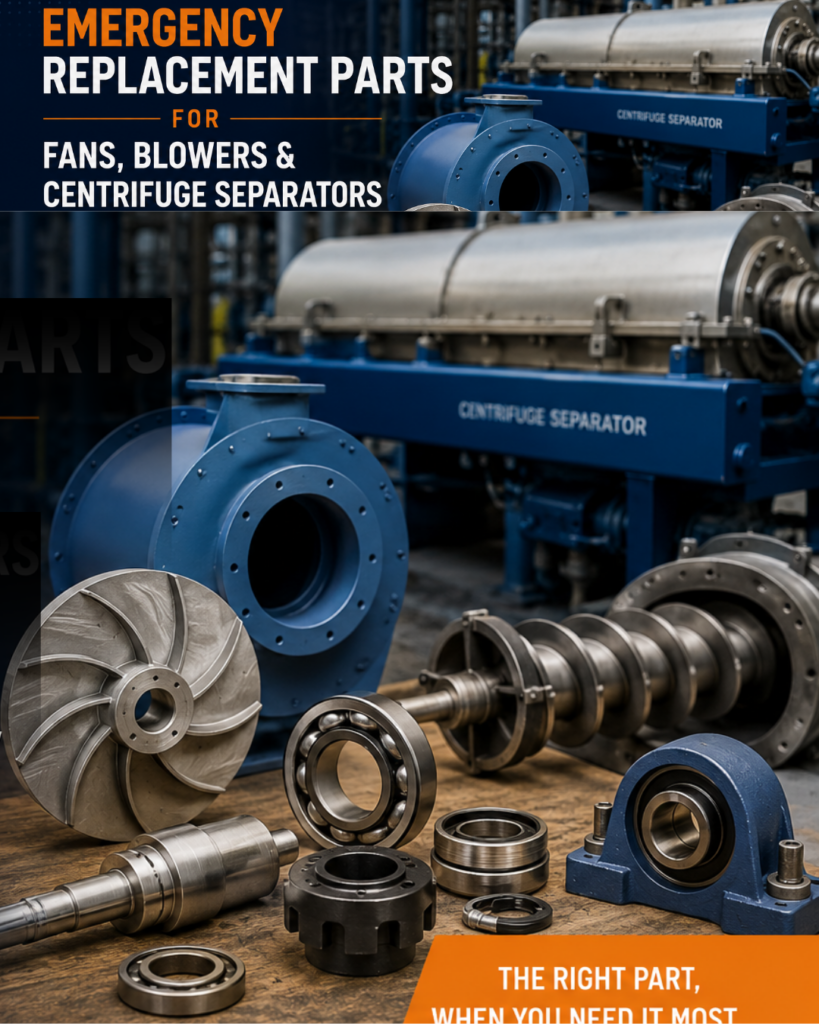
Most plant managers have experienced it at least once. Everything is running normally until a fan begins vibrating excessively, a blower suddenly loses performance, or a centrifuge trips unexpectedly. Within minutes, production slows down. Within hours, maintenance teams are searching for a replacement component that should have been available before the failure occurred.
The cost of a breakdown is rarely limited to the damaged part itself. Lost production, delayed shipments, overtime labor, and emergency procurement often create a much larger financial impact than the component that failed.
This is why many high-performing facilities place as much importance on spare parts planning as they do on preventive maintenance.
Downtime Doesn’t Wait for Procurement
Industrial fans, process blowers, and centrifuge separators are often treated as support equipment until they stop working.
A dust collection fan that goes offline can affect environmental compliance and worker safety. A blower failure can interrupt pneumatic conveying or aeration processes. A centrifuge shutdown can create a bottleneck that impacts an entire production line.
In these situations, the real challenge is not identifying the failed component. It is obtaining the replacement quickly enough to avoid extended downtime.
Many facilities discover that custom impellers, shafts, centrifuge scrolls, or specialized bearings may require weeks to source if they are not already available.
The Components That Commonly Cause Unplanned Shutdowns
Not every component deserves a place in your critical spare inventory. The focus should always be on parts that are difficult to source, expensive to repair, or capable of stopping production.
For industrial fans, the most common emergency requirements often include impellers, shafts, bearings, coupling assemblies, and wear liners. Facilities handling abrasive dust frequently experience accelerated wear, particularly in high-velocity applications where particulate matter continuously impacts internal surfaces.
Blowers present a different set of challenges. Mechanical seals, rotor assemblies, bearing systems, and drive components typically experience the highest stress levels. In continuous-duty applications, even a relatively small bearing issue can quickly develop into a major repair if not addressed promptly.
Centrifuge separators operate under even more demanding conditions. High rotational speeds and continuous solids handling create wear on scroll conveyors, bowl assemblies, seals, and gearbox components. When one of these parts reaches the end of its service life unexpectedly, production schedules can be affected almost immediately.
What Separates Well-Prepared Plants from the Rest
The difference is usually not the quality of the equipment.
It is the quality of the planning.
Facilities with strong reliability programs rarely wait for a failure before identifying critical spare parts. They study maintenance records, review failure histories, and understand which components have the greatest impact on production continuity.
A chemical processing facility, for example, may keep replacement bearings and seal kits in stock because they represent the most frequent maintenance requirement. A wastewater treatment plant may prioritize centrifuge wear components because sourcing delays could affect treatment capacity.
The strategy varies from plant to plant, but the principle remains the same, critical equipment deserves critical spare support.
Looking Beyond the Purchase Price
One of the most common mistakes in spare parts planning is evaluating inventory solely based on purchase cost.
A replacement bearing may cost a few hundred dollars. A production interruption caused by the absence of that bearing may cost thousands or even lakhs of rupees per hour.
When viewed from this perspective, maintaining essential replacement components becomes less of an inventory expense and more of an operational safeguard.
The conversation shifts from “What does this spare part cost?” to “What would it cost if we didn’t have it?”
Predictive Maintenance Makes Spare Parts More Effective
Modern maintenance programs are increasingly combining condition monitoring with spare parts management.
Vibration analysis, thermal inspections, oil analysis, and performance monitoring provide valuable early warning signs. Instead of reacting to failures, maintenance teams gain time to schedule repairs and prepare replacement components in advance.
This approach not only reduces emergency breakdowns but also improves inventory planning. Plants can maintain the right parts rather than simply maintaining more parts.
Working with the Right Support Partner
When emergencies arise, access to technical expertise can be just as important as access to replacement components.
A reliable service partner can help identify equivalent parts, recommend upgrades, expedite manufacturing, and support installation activities when time is critical.
For equipment such as industrial fans, blowers, and centrifuge separators, where designs are often application-specific, this support can significantly reduce recovery time.
Final Thoughts
Equipment failures cannot always be prevented. Wear, process conditions, and operating demands ensure that every rotating machine will eventually require maintenance.
What organizations can control is how prepared they are when that moment arrives.
Facilities that maintain critical replacement parts, review equipment reliability regularly, and plan for emergency situations are often able to recover quickly, while others face prolonged downtime.
In industrial operations, preparedness is rarely visible when everything is running smoothly. Its value becomes clear the moment a critical machine stops.
At Atmax Filtration Elements Inc, we understand that industrial ventilation failures can directly impact production, safety, and operational efficiency. Our approach to emergency breakdown support focuses on rapid response, practical troubleshooting, and reliable replacement solutions for industrial fans, blowers, dust collectors, and ventilation systems.
By combining technical expertise with field-level industry experience, we help facilities reduce downtime, restore airflow performance, and maintain stable operations during critical situations. From emergency spare-part support to ventilation system diagnostics and maintenance assistance, Atmax Filtration remains committed to supporting industries with dependable and efficient industrial ventilation solutions built around long-term reliability and operational continuity.