
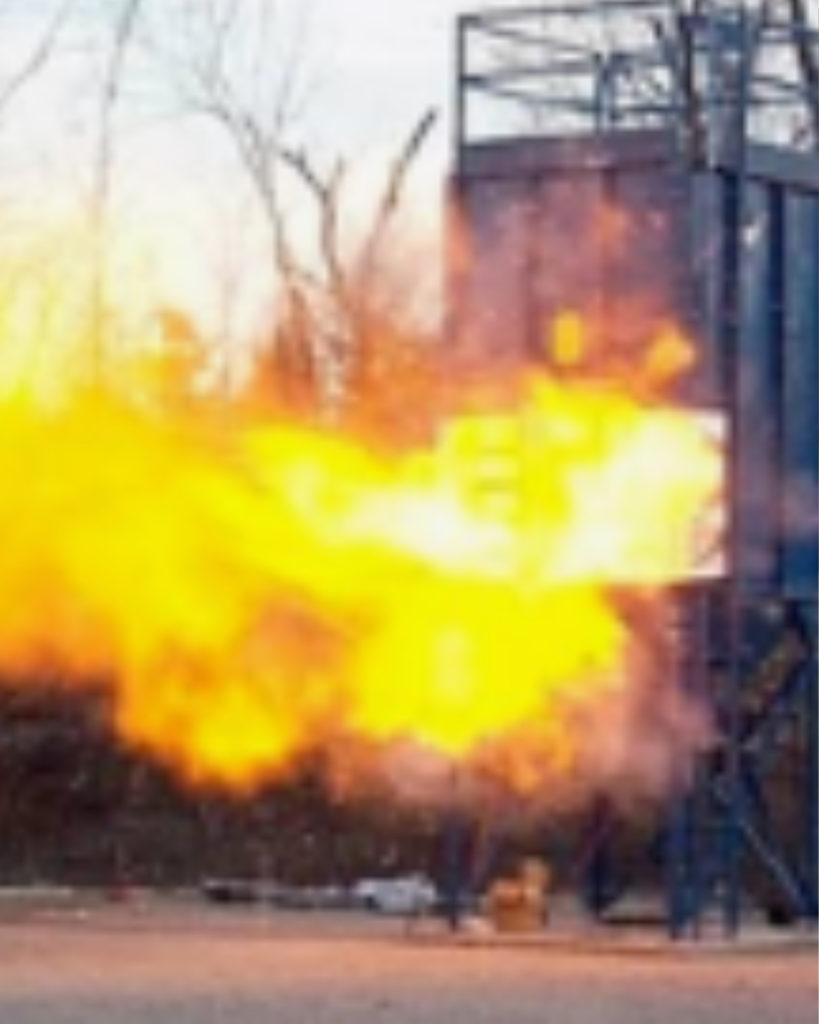
Most plant managers don’t think about their dust collector until something goes wrong, a filter fails, pressure spikes, or worse. But a dust collector explosion is usually the result of a few ordinary, preventable problems that were allowed to build up over time; Dust settling where it shouldn’t, a spark source that went unnoticed, airflow that slowly drifted out of spec.
Here’s a clear look at how these explosions happen, what puts your system at risk, and the steps that keep your plant safe.
The Five Conditions Behind Every Explosion
Safety engineers call it the dust explosion pentagon. An explosion isn’t one big failure. It’s five smaller conditions coming together at once.
You need combustible dust, oxygen, an ignition source, dust floating in the air, and confinement (your collector housing does this job). Remove just one of these five, and an explosion can’t happen.
Oxygen and confinement are part of how a collector works, so you can’t design those away. That leaves three things you can control, how much dust builds up, whether it becomes airborne, and whether a spark ever reaches it.
Ignition sources are the hardest to predict. A poorly grounded duct can build up static electricity without anyone noticing. A bearing that runs hot for days can go unnoticed until it’s the hottest thing in the room. Sparks from nearby cutting or welding can travel farther than expected. None of these look dangerous at the moment. That’s exactly why they matter.
Common System Problems to Watch For
A well-maintained collector behaves very differently from one that’s been neglected. The same few problems tend to show up again and again:
- Low duct velocity. Dust needs steady airflow to keep moving. When velocity drops, dust settles inside the ductwork instead of reaching the collector, leaving fuel sitting exactly where it shouldn’t be.
- Poor grounding and bonding. Static charge needs somewhere to go. Without a clear path to ground, it escapes as a spark.
- Leaking doors and gaskets. A small leak doesn’t just waste air, it can stir up settled dust and put it back into the air.
- Overloaded filters. Filters running past their design pressure change how air moves through the system, often without obvious warning signs.
None of these problems look serious on their own. That’s what makes them dangerous, small maintenance issues that quietly grow into major hazards.
Combustible Dust
Many everyday materials produce combustible dust, such as aluminum, magnesium, and titanium, wood, grain and flour, sugar; paper, plastics and resins, pharmaceuticals, and a wide range of chemicals. Materials that seem harmless in solid form can become hazardous once ground fine enough to stay airborne, generally under 500 microns, according to NFPA 652.
How dangerous a material is depends on its particle size, moisture, shape, density, and volatility.If you’re unsure what you’re handling, get it tested. Testing provides two key numbers — Kst (explosion severity) and Pmax (maximum pressure), which guide how your protection systems should be designed.
On the regulatory side, NFPA 660 now combines what used to be spread across NFPA 652, 484, and other standards. This gives facilities one clear, unified source of guidance instead of several separate documents.
Warning Signs Worth Taking Seriously
Explosions rarely happen without warning. Watch for:
- Dust layers building up on rafters, beams, or equipment
- Hot spots or a burning smell near process equipment
- Static discharges you can see, hear, or feel
- Unusual noise or vibration from the collector
- Filters failing more often than they should
- Differential pressure creeping up with no change in load
- Pressure pulses that seem erratic
One of these alone might mean nothing. Several together or one that keeps happening is worth investigating right away, before it turns into an OSHA inspection or a real incident.
Dust Explosion Prevention
The strongest approach to explosion prevention works on three levels.
Design. This is where most prevention happens. Choose the right collector type and filtration media for your process. Size ductwork so air velocity keeps dust moving instead of settling. Keep air-to-cloth ratios in range, and make sure offline cleaning cycles are actually working. Ground and bond the entire system. Keep process zones isolated so a problem in one area can’t easily spread.
Protection. Where a Dust Hazard Analysis shows real risk, add explosion venting, isolation valves, and spark detection. Venting gives built-up pressure a safe place to release. Isolation valves on inlet and outlet ducts stop flame from spreading between connected equipment. Spark detection and arrestors catch ignition sources before they ever reach the collector. For higher-risk applications, wet collection is also worth considering, it largely removes the risk of airborne dispersion.
Maintenance. None of this matters if it isn’t checked regularly. Replace filters on a schedule, not after they fail. Check for leaks. Test hoppers and airlocks. Verify valves and controls. And keep up with housekeeping simple, consistent cleaning that keeps dust from building up where it shouldn’t.
Dust Hazard Analysis
If your facility handles combustible dust, a current Dust Hazard Analysis (DHA) is required. It should be reviewed at least every five years, or sooner if your process changes significantly. The goal is simple: identify every fire and explosion hazard, understand the potential consequences, and put controls in place that match the actual risk.
How Atmax Approaches Dust Collector Safety
At Atmax, we design prevention into our dust collection systems from the start. That means proper sizing, integrated spark control, explosion venting matched to your process, and grounding done correctly the first time. For processes involving hot work, our WeldPack and LaserPack configurations are built to address ignition risks at the source.
We also know that good specs only matter if a system is installed correctly, maintained consistently, and adjusted as your process evolves. That’s why our team stays involved after startup, helping you interpret DHA findings, meet NFPA and OSHA requirements, and keep your system aligned with your operation over time.
If it’s been a while since your dust collection system was reviewed, or if any of the warning signs above sound familiar, it’s worth a conversation now. Reach out to Atmax to schedule a system inspection or talk through what a properly protected setup looks like for your facility.