
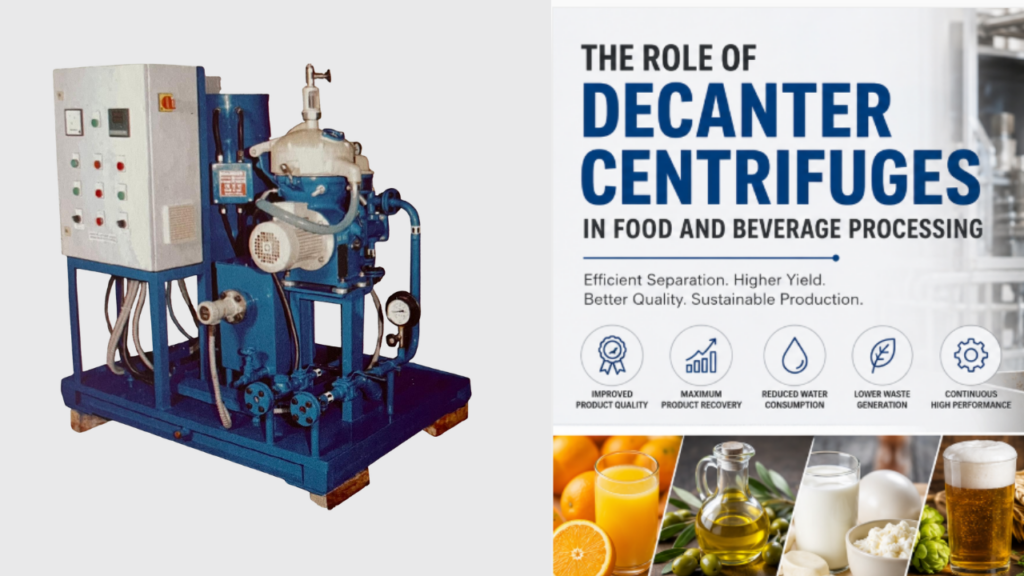
The food and beverage industry operates in an environment where product quality, production efficiency, and regulatory compliance are equally critical. Manufacturers are continuously seeking technologies that can improve process performance while reducing resource consumption and operating costs.
One of the most important technologies supporting modern food production is the decanter centrifuge. From fruit juice clarification and edible oil extraction to dairy processing and brewery operations, decanter centrifuges have become an integral part of industrial food processing because of their ability to perform efficient and continuous solid-liquid separation.
As production volumes increase and quality requirements become more demanding, decanter centrifuges help processors achieve consistent product quality, improve recovery rates, and optimize the use of water, energy, and raw materials.
What are Decanter Centrifuges
A decanter centrifuge is a continuous separation system that uses centrifugal force to separate solids from liquids based on differences in density.
The equipment primarily consists of:
- A rotating cylindrical-conical bowl
- An internal screw conveyor
- Feed and discharge assemblies
- Differential speed control mechanisms
The process begins when the product slurry enters the rotating bowl. As the bowl spins at high speeds, centrifugal forces that are several thousand times greater than gravity act upon the mixture.
The heavier solid particles migrate toward the bowl wall, forming a compact layer of solids. The lighter liquid phase moves toward the center of the bowl and exits separately. Meanwhile, the screw conveyor continuously transports the separated solids toward the discharge end.
This continuous process enables decanter centrifuges to handle large volumes efficiently without interrupting production, making them particularly suitable for food and beverage manufacturing environments.
Why Efficient Separation Matters in Food Processing
Nearly every food manufacturing process involves some form of separation. Whether the objective is to remove solids from liquids, recover valuable ingredients, clarify products, or dewater by-products, separation efficiency directly influences operational performance.
An effective separation process impacts:
- Product purity and consistency
- Production throughput
- Recovery of valuable ingredients
- Energy consumption
- Water usage
- Waste generation
- Operating costs
Even minor improvements in separation efficiency can significantly influence plant profitability, especially in facilities operating continuously.
Decanter centrifuges address these challenges by providing reliable and high-capacity separation while maintaining consistent process performance.
Applications of Decanter Centrifuges in Food and Beverage Processing
Fruit and Vegetable Juice Processing
The production of fruit and vegetable juices generates substantial amounts of pulp, fibers, seeds, and suspended solids that must be removed without compromising product yield.
Decanter centrifuges are widely used for processing:
- Apple juice
- Citrus juices
- Grape juice
- Berry concentrates
- Tomato products
- Vegetable extracts
Benefits
Improved Product Clarity- The centrifuge effectively removes suspended solids, producing clearer and more visually appealing products.
Higher Juice Recovery- Efficient separation allows manufacturers to recover a greater percentage of valuable liquid from the pulp.
Reduced Downstream Filtration Load- By removing large amounts of solids at an early stage, decanter centrifuges improve the efficiency and service life of downstream filtration equipment.
Continuous High-Volume Processing- Continuous operation supports large-scale production while maintaining product consistency.
Edible Oil Extraction and Processing
Edible oil manufacturing requires efficient separation of oils, water, and residual solids throughout various stages of production.
Decanter centrifuges are commonly used in:
- Palm oil processing
- Olive oil extraction
- Sunflower oil production
- Soybean processing
- Vegetable oil refining
Benefits
Higher Oil Recovery- Efficient separation minimizes residual oil losses and maximizes product yield.
Improved Process Stability- Continuous operation ensures stable production conditions and consistent product quality.
Lower Waste Generation- Recovering more oil from the process reduces disposal requirements and improves overall process economics.
Because even small increases in oil recovery can generate significant financial benefits, separation efficiency is a major performance indicator in edible oil manufacturing.
Brewery and Beverage Production
Breweries and beverage manufacturers depend on precise clarification processes to achieve the desired product appearance, taste, and shelf life.
Decanter centrifuges are extensively used for:
- Yeast separation
- Beverage clarification
- Fermentation residue removal
- Recovery of valuable process streams
Benefits
Consistent Product Quality- Stable separation performance contributes to uniform product characteristics.
Reduced Product Losses- Greater recovery of valuable liquids improves production economics.
Improved Production Efficiency- Continuous operation minimizes process interruptions and supports high production capacities.
In modern beverage manufacturing, reliable clarification processes directly contribute to brand consistency and customer satisfaction.
Dairy Processing
Dairy operations involve handling complex mixtures containing fats, proteins, solids, and moisture.
Decanter centrifuges support various dairy processes, including:
- Whey concentration
- Protein recovery
- Sludge dewatering
- By-product management
- Process stream clarification
Benefits
Enhanced Recovery of Valuable Ingredients- Efficient separation helps recover proteins and other valuable components that might otherwise be lost.
Reduced Waste Volumes- Effective dewatering minimizes waste handling and disposal requirements.
Improved Process Efficiency- Continuous processing allows dairy manufacturers to maintain stable production operations while optimizing resource utilization.
Starch and Food Ingredient Manufacturing
The production of starches and food ingredients often involves processing highly concentrated slurries and recovering fine particles.
Applications include:
- Starch recovery
- Protein separation
- Slurry thickening
- Ingredient purification
- By-product recovery
Benefits
Improved Separation Efficiency- High centrifugal forces allow efficient handling of fine particles and high-solids streams.
Better Product Consistency- Controlled separation improves the uniformity of final products.
Higher Throughput- Continuous operation supports large-scale manufacturing requirements.
Advantages of Decanter Centrifuges in Food and Beverage Manufacturing
1.Continuous Operation- Decanter centrifuges operate continuously, enabling processors to achieve higher production capacities while reducing process interruptions.
2.Improved Product Recovery- Food processing often involves handling valuable raw materials. Decanter centrifuges maximize recovery rates and minimize product losses, directly improving profitability.
3.Consistent Product Quality- Modern food manufacturing demands repeatable and controlled processing conditions. Decanter centrifuges provide stable separation performance, resulting in uniform product characteristics.
4.Lower Water Consumption- Efficient separation reduces the need for repeated washing, reprocessing, and additional treatment steps, helping facilities conserve water.
5.Reduced Waste Generation- By improving recovery and dewatering performance, decanter centrifuges significantly reduce waste volumes and disposal costs.
6.Compact Installation Footprint- Multiple separation functions can often be integrated into a single machine, allowing manufacturers to optimize plant space utilization.
7.Lower Operating Costs- Efficient separation contributes to:
- Reduced product losses
- Lower water consumption
- Reduced waste disposal expenses
- Improved process productivity
- Optimized manpower requirements
The combined effect often results in a lower total cost of ownership.
How to Select the Right Decanter Centrifuge
The performance of a decanter centrifuge depends on selecting equipment that matches the specific process requirements.
Important considerations include:
Product Characteristics
- Solids concentration
- Particle size distribution
- Viscosity
- Temperature
- Abrasiveness
Process Requirements
- Desired throughput
- Product recovery targets
- Moisture content requirements
- Clarification efficiency
- Product quality objectives
Operational Factors
- Ease of maintenance
- Material compatibility
- Hygienic design requirements
- Energy efficiency
- Automation and process control capabilities
A properly engineered decanter centrifuge not only delivers superior separation performance but also ensures long-term reliability and operational efficiency
Conclusion
Decanter centrifuges have become essential equipment in modern food and beverage processing because of their ability to deliver reliable, continuous, and highly efficient solid-liquid separation.
Whether processing fruit juices, edible oils, dairy products, starches, or beverages, these systems help manufacturers improve product quality, maximize yield, reduce waste, and optimize resource utilization.
As the industry continues to focus on efficiency, sustainability, and product consistency, investing in properly engineered decanter centrifuge solutions can provide significant long-term advantages in productivity, profitability, and environmental performance.