
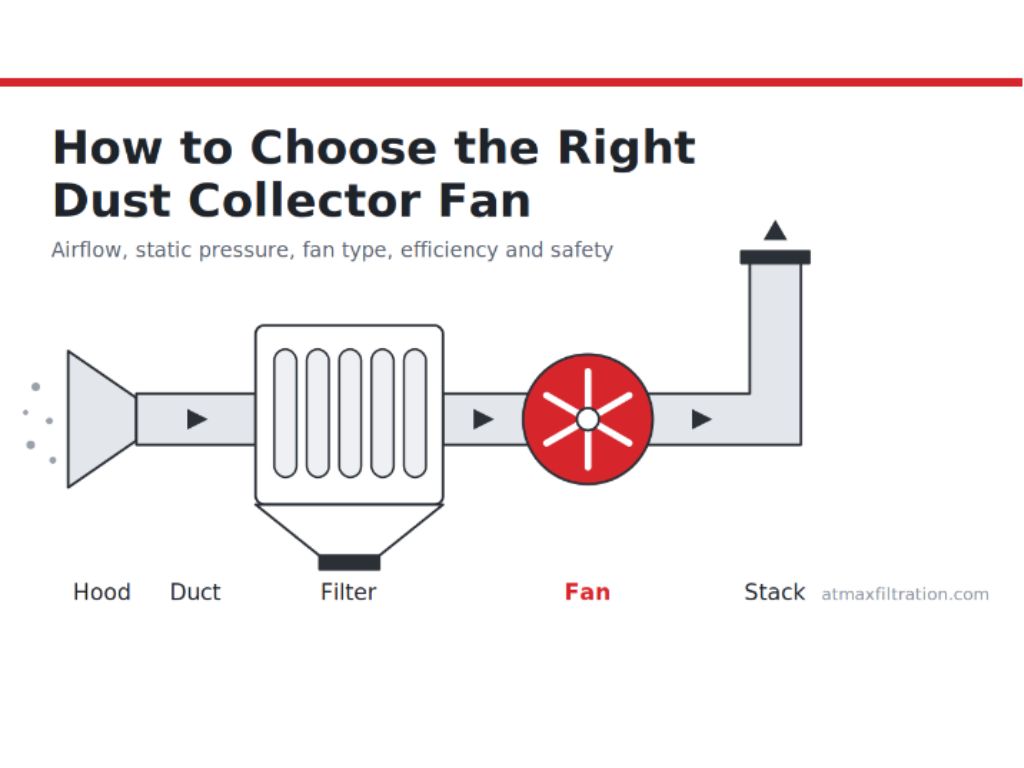
How to Choose the Right Dust Collector Fan
The fan is the heart of any industrial dust collection system. It creates the suction that pulls dust from your process, carries it through the ductwork, and moves it through the filters. If the fan is wrong, nothing else in the system can make up for it. An undersized fan leaves dust uncaptured. An oversized one wastes energy, adds noise, and wears out filters sooner.
Most dust collector fans pull air through the system (induced draft), though some push it. This guide covers the five decisions that matter most when selecting an industrial fan for dust collection, from the numbers you need to the pitfalls to avoid.
In this guide:
- Define your airflow (CFM)
- Calculate total static pressure
- Size the fan using its fan curve
- Match the fan type to your dust
- Plan for efficiency, noise, and safety
Then: choosing a supplier, common mistakes, and an FAQ.
1. Define your airflow requirement (CFM)
Airflow, measured in cubic feet per minute (CFM), is the volume of air the fan must move. It is driven by two things:
- Capture needs at each hood or pickup point. The airflow must be enough to catch dust at the source.
- Transport velocity in the duct. Air must move fast enough to keep dust from settling and clogging the line. Depending on the material, this is commonly in the range of 3,500 to 4,500 feet per minute.
Add up the airflow of all the pickup points that run at the same time, allowing for blast gates that will be closed. Don’t guess here. Every later calculation builds on this number.
2. Calculate total static pressure (in. w.g.)
Static pressure is the resistance the fan must overcome, measured in inches of water gauge (in. w.g.). It is the total of every restriction in the system. Here is an illustrative example:
System component | Pressure loss (in. w.g.) |
Hood entry loss | 1.0 |
Duct friction and elbows | 2.5 |
Cyclone / pre-separator | 1.5 |
Filter (at dirty, end-of-life condition) | 4.0 |
Outlet, stack, silencer | 1.0 |
Total | 10.0 |
Two points are often missed. First, filter pressure drop rises as filters load with dust, so size the fan for the dirty-filter condition, not the clean one. Second, if you size for a clean filter, the system will lose airflow as the filters load. For more on this, see our post on upward airflow problems in dust collectors.
3. Size the fan using its fan curve
A fan doesn’t have one CFM rating. It has a fan curve showing how much air it moves at each pressure. Your system has its own system curve, since resistance rises as airflow rises. The point where the two curves cross is the operating point, and it should land close to the fan’s peak efficiency, not at the far edges of its curve.
Once you know the operating point, estimate the power required:
Brake horsepower = (CFM × static pressure) ÷ (6356 × static efficiency)
For example, at 10,000 CFM and 10 in. w.g. with a fan at 65% static efficiency:
(10,000 × 10) ÷ (6356 × 0.65) ≈ 24 bhp
You would then choose a motor with margin, such as 30 hp, to allow for drive losses and service factor.
Two more sizing factors:
- Air density. High temperature or altitude lowers air density, which changes the fan’s performance. Ask your supplier to correct it.
- The fan laws. Airflow changes in proportion to speed, pressure with the square of speed, and power with the cube of speed. See our guide to the fan affinity laws and how to size a centrifugal fan.
4. Match the fan type to your dust
This is the decision that most affects long-term reliability. The right blade design depends on how much dust passes through the fan and how abrasive or sticky it is.
Fan type | Efficiency | Dust tolerance | Noise | Best for |
Radial blade | Lower | Highest. Sheds buildup and withstands abrasion | Higher | Heavy dust loading, abrasive or sticky material, dirty-air side |
Backward inclined | Moderate to high | Moderate | Lower | Light to moderate dust loading |
Backward curved | High | Lower to moderate | Lower | Mostly clean air; high-pressure systems |
Airfoil | Highest | Low | Lowest | Clean air only, usually after the filter |
Where the fan sits matters as much as the type. Most baghouse and cartridge systems put the fan on the clean-air side, after the filters, so dust never passes through it. That makes efficient fan designs like airfoil and backward curves possible. If the fan must handle the dirty air stream, choose a rugged radial blade design, often with wear liners.
Browse our centrifugal fans and blowers and high pressure blowers for the types above.
5. Plan for efficiency, noise, and safety
Efficiency and operating cost. Over a fan’s life, electricity usually costs far more than the fan itself. Look for AMCA-certified performance ratings, and consider a variable frequency drive (VFD). Because power drops with the cube of speed, slowing a fan by 20% cuts its power use by roughly half. Belt or direct drive also affects cost and maintenance, as covered in Belt-Drive vs. Direct-Drive Industrial Fans.
Noise. OSHA’s action level for hearing conservation is 85 dBA averaged over an 8-hour shift. Ask for sound data at your operating point, and consider silencers, enclosures, or lower tip speeds. If you already have a noise problem, see our fan noise diagnosis guide.
Combustible dust. Wood, metal, grain, plastic, and many chemical dusts can ignite. If yours can, specify spark-resistant construction (AMCA 99), suitably rated motors, and a system designed to NFPA guidelines (such as NFPA 652, 68, and 69) with explosion venting. Read more in Dust Collector Explosions.
Materials. Corrosive, hot, or wet streams may call for stainless steel, fiberglass, or lined construction. See our stainless steel and fiberglass and plastic fans.
Choose the right supplier
A fan that looks right on paper can still fail in the field if the supplier doesn’t understand your process. Look for:
- Performance data backed by AMCA-certified testing
- Engineers who ask about your dust, temperature, and ductwork, not just your CFM
- Custom construction options and fast access to spare parts
- Support after installation, including balancing, commissioning, and maintenance
Common mistakes to avoid
- Sizing for clean filters instead of dirty ones
- Choosing a fan by CFM alone and ignoring static pressure
- Using a clean-air fan (airfoil) in a dusty airstream
- Oversizing “to be safe,” which raises energy use, noise, and wear
- Ignoring combustible dust requirements
- Not planning for future expansion or added pickup points
For more, see Dust Collector Mistakes in Woodworking Plants.
Get help sizing your dust collector fan
Not sure where your numbers land? Send us your CFM, static pressure, dust type, and operating temperature, and our engineers will recommend a fan. Request a quote or contact us
Frequently Asked Questions
It depends on the dust. Radial blade fans suit heavy, abrasive, or sticky dust. Backward inclined, backward curved, and airfoil fans are more efficient and quieter, but are best for cleaner air, typically on the clean side of the filter
Add up the airflow required at each pickup point that runs at the same time. Each is based on capture velocity at the hood, while the duct must also maintain a minimum transport velocity.
Not usually. Oversizing wastes energy, increases noise, and can shorten filter life. It’s better to size accurately and add a VFD for flexibility.
Usually on the clean-air side, after the filters, so dust doesn’t pass through it.
Often yes. Spark-resistant construction and properly rated motors are commonly required, along with explosion protection for the whole system.