
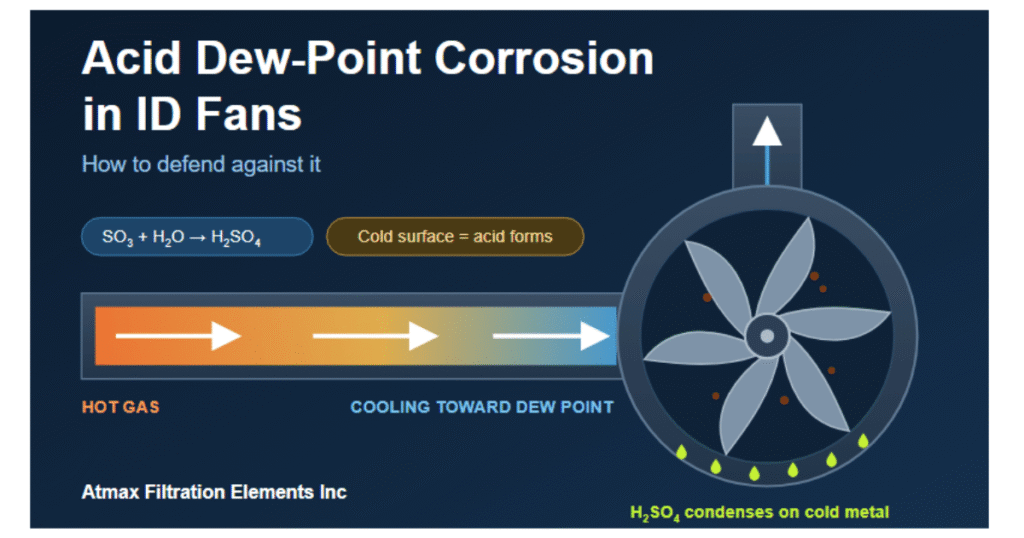
Acid Dew-Point Corrosion in ID Fans
Your ID fan can be eaten away from the inside by a gas you measure in single-digit parts per million. That gas is sulfur trioxide (SO₃), and the damage it causes is called acid dew-point corrosion.
It seldom arrives as a dramatic failure. Vibration creeps up between outages. A casing panel looks permanently damp. The impeller you repaired last spring is pitted again. By the time someone connects the dots, the fan has often been running through acid for months.
This post covers how the problem starts, where it hits an ID fan, how to estimate your own dew point, and what actually helps.
What is acid dew-point corrosion
Burn a fuel that contains sulfur and most of it leaves the furnace as SO₂. A small share turns into SO₃. An SCR system can raise that share, since the catalyst oxidizes some extra SO₂ on the way through.
Once the gas cools below roughly 600–700°F (315–370°C), SO₃ picks up water vapor and becomes gaseous sulfuric acid. By the time gas has dropped to around 280–320°F (140–160°C) past the air heater, most of the SO₃ is in that form, according to Power magazine’s series on SO₃.
The acid dew point is the temperature where that vapor turns to liquid on a surface. It is the surface that has to be cold, not the gas. An uninsulated access door, a stiffener bolted across the casing or a leaky seal can sit well below the dew point while your gas temperature trend looks fine.
Water has its own dew point too. Below it, CO₂ forms weak carbonic acid, and chlorides from waste fuels or biomass can add hydrochloric acid. That is one reason corrosion sometimes doesn’t match what the SO₃ numbers alone would predict.
Your acid dew point is higher than you'd guess
Most people think of 212°F as the line where water condenses. With even a little SO₃ in the gas, sulfuric acid condenses far above that. Power magazine’s published figures show how quickly it climbs:
SO₃ in flue gas | Approximate acid dew point |
3 ppm | about 255°F (124°C) |
10 ppm | about 275°F (135°C) |
60 ppm (high-sulfur coal, SCR running) | about 310°F (154°C) |
The same source says that stripping 95% of the SO₃ from a 10 ppm stream would pull the dew point from about 275°F to about 235°F. On a 60 ppm stream it would drop from about 310°F to about 255°F. Other references give a general range of 80–150°C, depending on fuel sulfur and excess air.
Treat all of these as ballpark figures. Your real number depends on fuel, moisture, excess air, SCR operation and ammonia slip. The practical point is simple: SO₃ going from 3 ppm to 60 ppm can move the dew point by 50°F or more. A temperature margin chosen before an SCR retrofit or a fuel change may no longer exist.
Where the damage shows up on an ID fan
The ID fan usually sits after the air heater and the particulate collector, so the gas has already lost a lot of heat when it arrives. These are the usual trouble spots:
- Inlet box and inlet cone. Cold corners, stagnant gas and air in-leakage all invite condensation.
- Casing and scroll. Thin insulation, bare stiffeners and access doors act as cold bridges.
- Impeller blades, backplate and hub. Acid mixes with fly ash into a sticky deposit that is hard to clean off.
- Shaft seals and bearing housings. Seal or cooling air meets hot gas here.
- Low points and drains. Condensate collects and the acid gets stronger.
- Fans downstream of a wet FGD. The gas leaving a wet scrubber is saturated and can carry fine acid aerosol formed by rapid cooling.
Erosion makes everything worse. Fly ash wears through paint, and once bare steel is exposed the acid has a way in. Fan users describe this pattern often: the erosion isn’t severe, but it is what lets the corrosion start.
What it costs you
Corrosion on a spinning impeller is more than metal loss. It leaves a rough surface and uneven mass loss, and that means vibration. One fan manufacturer’s guide to corrosion-resistant fans lists rising vibration and coatings that blister or flake within two to three years as common warning signs. It also says a fan built for 15 years can end up on a three-to-five-year replacement cycle when several corrosive factors stack up. That is a vendor’s view of general corrosive service, not an ID-fan-specific study, but it matches what plant teams tell us.
The bill tends to include:
- Emergency repairs and a forced outage.
- Rebalancing, plus bearing and shaft wear from the vibration.
- More fan power as deposits and roughness raise resistance.
- Knock-on damage to ductwork, dampers and the baghouse or precipitator ahead of the fan.
Find your number before you chase fixes
You can’t defend against a dew point you haven’t pinned down. Use three methods together:
- Calculate it. Empirical correlations such as Verhoff–Banchero take your moisture and SO₃ values and return a dew point. Redo the calculation whenever fuel, load or SCR operation changes in a meaningful way.
- Measure SO₃. Controlled condensation sampling gives you real SO₃ and sulfate data instead of an assumed conversion rate. Oxy-combustion research has found measured dew points that differ from theoretical estimates, which is a good reason to check.
- Monitor it online. Acid dew-point monitors help you stay close to the safe limit without overheating. Run too cold and you get acid deposits. Run too hot and you throw away efficiency.
Then look at metal surface temperatures, not only gas temperature. An infrared survey of the casing, inlet box and ducts at normal and low load is cheap, and it often finds cold bridges nobody knew about.
Six defenses that work
1. Keep a temperature margin above the dew point
Standard practice is to hold the air heater gas outlet about 20–30°F above the acid dew point, to cover air in-leakage. For baghouses, a common design rule is an inlet at least 25–40°F above the highest expected dew point. Many specs also cap the temperature drop from baghouse inlet to outlet at about 10°F, since heat loss across the collector is a frequent cause of acid mist condensing. Revisit these margins after any fuel or emissions-equipment change.
2. Insulate, seal and heat the cold spots
The cheapest protection is thermal. Insulate the casing, inlet box and ducts. Shield or insulate stiffeners and doors. Fix in-leakage. Add heat tracing or purge heat where gas can sit still. Put drains at low points so condensate can’t pool and concentrate. Aim for even, steady flow near the dew point, because gas that lingers cools locally.
3. Cut SO₃ at the source
Every ppm you remove lowers the dew point. Your options:
- Fuel choice. Use lower-sulfur coal, or limit high-sulfur blends and pet coke co-firing, which can raise dew points sharply.
- SCR catalyst. Pick formulations with low SO₂-to-SO₃ conversion and keep ammonia slip tight to avoid sticky ammonium bisulfate.
- Sorbent injection. Injecting a reagent ahead of the air heater to capture SO₃ is common, and the figures above show it can lower the dew point by 40–55°F.
4. Match the material to the chemistry
No coating or alloy resists everything, so this is always a trade of cost against service life. Roughly from cheapest to most capable:
- Coated carbon steel. Lowest first cost, but coatings can fail early in acid service and erosion shortens them further.
- 304 and 316L stainless. A passive oxide layer means nothing to recoat, but they can still pit in chlorides or under condensing acid. One user reported moving an impeller from 304 to duplex 2205 after erosion and corrosion trouble on a coal-fired heater.
- Duplex, super-duplex and 904L. Better chloride resistance and strength, often chosen for coastal or high-chloride service.
- Nickel alloys, FRP and polymer components. For the harshest acid and alkali exposure, at a much higher price.
Fan makers also point out that coating wear can be uneven, and uneven wear unbalances an impeller. Test coatings and insulation together, not one at a time.
5. Protect the baghouse so it protects the fan
If a fabric filter sits ahead of your ID fan, it is both a victim of acid and a guard against it.
Research on PPS bag filters taken from coal plants found that failures often track with operating temperature repeatedly passing through the acid dew point. The acid and SO₃ oxidize the weak sulfur-carbon bonds in the PPS. Acid-wetted dust cake is also hard to clean, which raises differential pressure and fan load.
There is a second link. A bag that fails lets abrasive fly ash straight into the fan, and that erosion is what strips the coating and opens the door to corrosion. Your filter element choice matters as much as your fan metallurgy.
For acidic flue gas:
- Pick media that handles higher temperatures (above about 325°F for high-sulfur service) and resists acid.
- PPS runs continuously up to about 375°F (190°C) and does well against sulfuric acid in ordinary flue gas. High SO₂ or SO₃ can lower that ceiling, because condensed acid wets the cake. A PTFE membrane on PPS helps the dust release even when things get damp.
- Look at PTFE or PTFE-membrane constructions, or PPS/polyimide blends, if dew-point excursions or oxidizing species keep recurring.
- Skip fiberglass where the unit regularly runs near the dew point. It can fail quickly there.
6. Treat startup, shutdown and low load as the danger zones
A lot of acid damage builds up during transients. Preheat before you introduce flue gas. Keep hot purge air moving through isolated baghouse compartments. Bring units off line gradually, and don’t sit at low load for long without raising gas temperature. After a shutdown, wash and dry deposits before moisture and leftover acid go to work on idle metal.
Warning signs worth acting on
- Fan vibration trending up between outages.
- Baghouse differential pressure climbing, or a dust cake that feels sticky and won’t release.
- Wet, discolored or crusty deposits on the casing, inlet box, ducts or hopper walls.
- Blistered, flaking or pitted coating on blades and backplate.
- Liquid at drains or inside the housing after shutdown.
- Fan power rising at constant load.
- Filter bags in the same unit failing early or going brittle.
Conclusion
Acid dew-point corrosion is a system problem, and the filtration stage is one of the parts you can actually control. At Atmax Filtration Elements Inc we work with plant engineers and maintenance teams to match filter element media and construction to real operating conditions: temperature swings, SO₃ exposure and how easily the dust cake releases. The aim is cleaner gas reaching the equipment downstream, your ID fan included.
If you are dealing with short bag life, a sticky cake, rising baghouse differential pressure or fan vibration, send us your fuel type, gas temperature range and any SO₃ or dew-point data you have. We’ll go through media options and operating practices with you.
Frequently Asked Questions
SO₃ from fuel sulfur combines with water vapor to make sulfuric acid vapor. Any surface in the fan or duct that is colder than the acid dew point collects liquid acid, and the acid attacks the metal.
It depends on SO₃ and moisture. In coal service the acid dew point commonly falls between roughly 240°F and 310°F (about 115–155°C). Keep a margin of 20–40°F above the highest dew point you expect.
It can. The catalyst may convert more SO₂ into SO₃, which raises the dew point, and ammonia slip can leave sticky ammonium bisulfate on downstream equipment.
Not always. Stainless holds up well in many cases, but it can still pit in strong acid, chlorides or condensing conditions. Choose the alloy from your actual gas chemistry and temperature profile.
They keep abrasive ash out of the fan and help avoid acid-soaked deposits that raise pressure drop. Elements matched to your temperature and acid exposure protect the baghouse and the fan behind it.